

Learn / Practice
Java LLM practice (9): why can a cancelled answer overwrite a new conversation?
AI-APPS / BUILD · Engineering cases
18 controlled thread schedules test request ownership for streaming previews, completion and errors, with cancellation and bounded deduplication.
What was published after this article?
The original conclusions and next-step proposals are retained. These published follow-ups do not imply that every limitation has been resolved.
KEEP EXPLORING
Related content
- Engineering cases
Java LLM practice (10): why is the reader still running after cancellation?
30 local HTTP connections separate conversation invalidation, reader exit and server work, comparing Future interruption with socket closure.
View count unavailable
On this page 11
Pinned code · Raw evidence and audit · Experiment record
The previous experiment required a complete stream before committing a conversation turn. Completeness is necessary, but the answer may belong to a request that has already been cancelled.
Suppose A is answering, the user cancels it and starts B, and A's final callback was already queued. An unconditional text update can overwrite B. Even if B later restores the correct screen, the intermediate update was wrong.
This study adds a second question: does this callback still own the current request?
Choose product semantics before choosing concurrency
Transactional history, version tickets and this article serve different requirements. A later demo does not make every earlier policy wrong. Suppose the user starts A and then B:
| Requirement | Policy | Does B include A’s answer? | What happens to late A? |
|---|---|---|---|
| Answer both, with B continuing A | Serialize the session (Demo 05) | Yes, if A committed successfully before B reads history | B waits; it does not normally overtake A |
| Solve concurrently from the same history; accept one commit | First-committer-wins (Demo 06) | No, when both acquire version v | The first valid commit invalidates v; the other must reread history before retrying |
| B replaces the earlier intent | Latest-started-request-wins (Demo 09) | Not if A was still uncommitted | Starting B invalidates A, even if A finishes before B |
This is a semantic example, not an additional experiment:
Serialized:       start A → commit A → start B → commit B
First committer:  start A(v0) → start B(v0) → commit A(v1) → reject B
Latest started:   start A(e1) → start B(e2) → reject A     → commit B
If B fails after starting and A later succeeds, the policies still differ. Serialization keeps an already committed A. Version tickets can still accept A if B never committed. Latest-intent ownership does not resurrect A when B fails. Keeping both answers requires a queue or separate branches rather than a single active request.
Exercise: what if “latest request” means the last response to finish?
Slow A would overwrite faster B, violating latest-intent semantics. Use request identity and generation, not completion order. The runnable late-preview case demonstrates this failure.
Make the race observable
The late-preview schedule pauses A immediately before its preview update:
Main:   begin(A)
Worker: parse answer-A; wait before preview
Main:   begin(B); preview(B, answer-B)
Worker: preview(A, answer-A); complete(A)
Main:   complete(B)
The naive implementation replaces B's preview with A's and commits the old turn. Testing only the final screen can miss this. Every event therefore records the resulting preview and history, and the audit checks the entire trace.
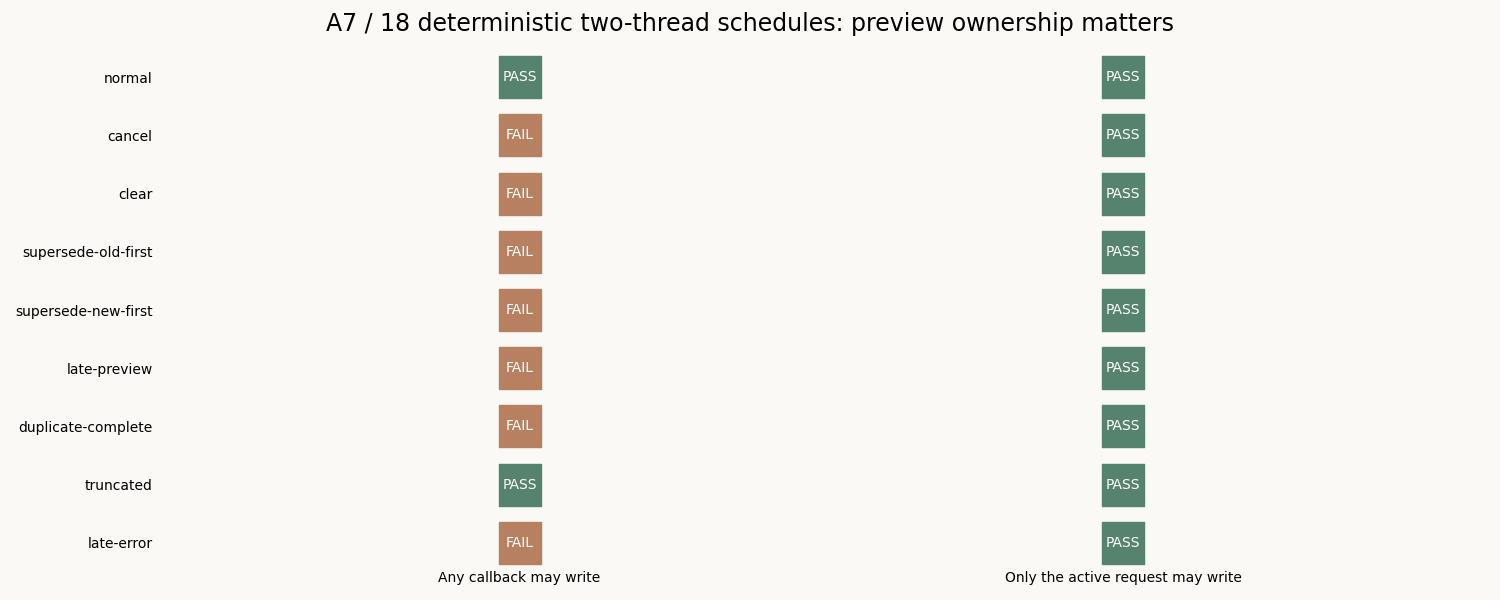
What actually ran
Java 8 runs a real worker thread alongside the main thread. Synthetic in-memory SSE passes through the unchanged A6 text parser. This is neither a new network benchmark nor an Agnes compatibility test; it makes no model requests.
Two latches establish the order: the worker announces that it reached the selected callback, then waits until the main thread has cancelled, cleared or replaced the request. The Java 8 CountDownLatch specification defines the visibility relationship between releasing and returning from the wait. Latches construct the test schedule, not the product session lock. A five-second timeout fails a stalled test; it is not a model latency measurement.
| Schedule | Unconditional callbacks | Active-request ownership |
|---|---|---|
| Normal completion | Pass | Pass |
| Completion after cancellation | Fail | Pass |
| Completion after clearing | Fail | Pass |
| Replace with B; A completes first | Fail | Pass |
| Replace with B; B completes first | Fail | Pass |
| A preview arrives after B preview | Fail | Pass |
| Duplicate completion callback | Fail | Pass |
| Truncated SSE | Pass | Pass |
| A error arrives after B begins | Fail | Pass |
There are 18 executions: seven of the nine naive schedules violate the contract; all nine guarded schedules pass. These are deterministic cases, not an estimated production failure rate or a proof covering every interleaving.
Give each request a write permit
begin returns a privately constructed Ticket with its owning session, generation (epoch), request ID and question. Every update checks:
t.owner == this && t == active && t.epoch == epochThe owner blocks cross-session tickets. Object identity selects the active request. The generation expresses invalidation after starting, cancelling or clearing. Successful completion clears active, so a second completion is rejected even if no newer request exists.
These are in-process ownership checks, not authentication.
Validate and mutate under the same lock
Checking outside the mutation is insufficient:
if (isCurrent(ticket)) {
    // cancel() or begin(B) could happen here
    history.add(answer);
}
The example synchronizes preview, completion, cancellation, clearing and failure on the same Session. Each validation and short state update is indivisible. Reading and parsing the stream stay outside the lock:
Session.Ticket ticket = session.begin(id, question);
if (ticket == null) return;
try {
    String answer = new StreamReader().read(input,
        text -> session.preview(ticket, text));
    session.complete(ticket, answer);
} catch (IOException ex) {
    session.fail(ticket);
}
complete assumes the caller has validated completion. Here the parser returns only after stop and [DONE]; calling it directly with partial text bypasses that boundary.
Error callbacks also have owners
A late exception from A can clear B's preview or loading state even when answer writes are guarded. The late-error schedule tests precisely this. Guarded fail(A) records STALE without changing B. Exceptions do not grant a callback permission to mutate a newer request.
Cancellation is local invalidation
Cancellation means A can no longer change this session. It does not promise that the provider stops generating or billing, that blocked I/O has been interrupted, that another server shares the same generation, or that request IDs survive a restart.
A real integration must also close connections and handle timeouts, and may use provider cancellation where supported. Local ownership must remain correct even when transport cancellation fails.
Bounded receipts are not permanent idempotency
The example retains eight used IDs and eight complete question/answer pairs. Reusing an ID does not start another request; changing the question under the same ID is also rejected. Clearing content retains the ID window to prevent immediate replay.
An evicted ID can be used again. This is finite, single-process deduplication, not durable idempotency. A production service needs authenticated session keys and an explicit receipt lifecycle. Diagnostic event snapshots are for this small experiment; production logs also need limits and redaction.
Check the environment before reproducing
Use a clean checkout of this article’s revision; the first article’s revision does not contain Demo 09:
git clone https://github.com/VirtualSelect/hohoo-ai-lab.git hohoo-ai-lab-session
cd hohoo-ai-lab-session
git checkout 920fee3717a373dc796269ee3a4a03ec33700ae3
java -version
mvn -version
Use Python 3, a Java 8-compatible JDK and Maven. Omit --offline on the first dependency download. Replace /path/to/mvn below with your executable (for example mvn.cmd on Windows). Expect nine trajectories per implementation, inspecting intermediate previews as well as final answers. Check PATH for a missing Maven, the revision for a missing directory, and choose a new output directory rather than overwriting evidence.
Review boundary, 2026-10-06: the reused Gson 2.10.1 parsing path still accepts unescaped line feeds and tabs inside strings despite setLenient(false). These ownership experiments do not prove strict JSON compliance. Add protocol rejection rules before using untrusted SSE; the original 18 trajectories are retained, not replaced by a new online experiment.
Reproduce and inspect
From hohoo-ai-lab:
python demos/09-stream-session/run.py --out demos/09-stream-session/evidence/my-run --maven /path/to/mvn
python demos/09-stream-session/audit.py demos/09-stream-session/evidence/my-run
Use --offline if Maven dependencies are cached. The archived execution used Java 8u171. results.json contains all 18 event traces and intermediate states. The manifest pins source and raw-file hashes. The audit independently reconstructs previews and history rather than accepting final counters. Seven additional contract groups cover ownership, cancellation, duplicate IDs, paired-history limits, receipt eviction and validation.
A successful answer now needs both protocol completeness and current ownership at commitment. The next integration should preserve both while testing real connection cancellation and multi-process state, rather than adding another HTTP-status check.
Fix follow-up · 2026-10-07
2026-10-07 correction: Demo08–10 now validate JSON lexical spelling; each passes 53 offline checks. Maven argument lists preserve output paths containing spaces, and Demo10 audits source fingerprints. The article’s pinned revision and original data remain unchanged; these fixes are not new online model results.
A note to your future selfBefore you move on, keep one thought of your own.
Your private reading note stays in this browser; it is never uploaded or published. Clearing browser data removes it, so export a copy to keep. This article’s translations share the same note.
Next published article:Java LLM practice (10): why is the reader still running after cancellation? →
You are here
BUILD / AI Applications
- ○ Java LLM practice (8): should an interrupted stream enter conversation history?
- ○ Java LLM practice (9): why can a cancelled answer overwrite a new conversation?
- ○ Java LLM practice (10): why is the reader still running after cancellation?
KEEP EXPLORING
Related content
- LAB / 024
Java LLM practice (9): why can a cancelled answer overwrite a new conversation?
18 controlled thread schedules test request ownership for streaming previews, completion and errors, with cancellation and bounded deduplication.
- PROJECT / 002
Java LLM Practice
Reproducible Java conversation, retry and persistence boundaries, alongside attention, cache-cost and quantization-error experiments.
- Engineering cases
Java LLM practice (8): should an interrupted stream enter conversation history?
22 loopback HTTP cases separate incremental preview from committing history, testing UTF-8, SSE framing, cancellation and abnormal endings.
- Tutorials
Calling an LLM with Java 8 — from one request to a conversation
Three runnable Java demos explain HTTP requests, JSON parsing, timeouts and conversation history.
Which way next?
- Calling an LLM with Java 8 — from one request to a conversation →
Three runnable Java demos explain HTTP requests, JSON parsing, timeouts and conversation history.
- Java LLM practice (8): should an interrupted stream enter conversation history? →
22 loopback HTTP cases separate incremental preview from committing history, testing UTF-8, SSE framing, cancellation and abnormal endings.
Based on article relationships and published same-topic content, not random recommendations.