Learn / Practice
Embodied practice II: if the grasp failed, skip the transfer
EMBODIED-AI · Engineering cases
An 18-rollout MuJoCo comparison of a lift/contact gate, with recorded trajectories, videos, runnable code and explicit limits.
EXPERIMENT RESULT
View count unavailable
On this page 8
In the first experiment, a 25 mm pickup offset left the cube on the table. The gripper nevertheless completed its timed transfer, lowering and release sequence.
This follow-up keeps the scene, friction, robot and pickup motion unchanged. It asks one narrower question: can observations collected during lifting prevent an empty transfer?
Across 18 rollouts, the gate cancelled all six transfers after biased pickups failed. The three zero-offset placements still completed, with entire trajectories identical to baseline. Failed grasps remained failures; the change improved the response to failure.
Code and reproduction · All 18 recordings · Lab
1. A phase deadline is not a phase precondition
The original high-level schedule was:
approach → descend → close → lift → transfer → lower → release → retreatAfter lifting, the next phase implicitly assumed that the cube was in the gripper. That assumption was false in the biased runs.
MuJoCo position actuators already use feedback. “Open-loop timing” here describes the high-level task sequence, which did not branch on pickup outcome; it does not mean that every control layer lacked feedback.
The new branch is small:
lift ends → check grasp
               ├─ accepted: original transfer and placement
               └─ rejected: hold actuator targets for 0.6 s, end episode
Holding actuator targets is neither attaching the cube nor a physical robot emergency stop. The program still advances physics normally, without editing cube poses or adding attachment constraints.
2. What counts as a confirmed grasp?
At simulation time 4.0 s, immediately after the lift phase, the controller checks the last 0.2 s of recorded observations. The thresholds were frozen in protocol.json before execution.
| Check | Threshold | Failure it addresses |
|---|---|---|
| Complete window | At least 10 samples spanning at least 0.18 s; successive gaps ≤0.0200001 s | One lucky sample or missing history |
| Fresh observation | Last sample age ≤0.025 s | Acting on stale state |
| Lifted cube | Every cube centre z >0.1 m | Gripper rises while cube stays behind |
| Bilateral contact | Both left_pad and right_pad in every sample | One-sided or fleeting contact |
| Finite height | No NaN or Infinity | Invalid values bypassing validation |
The height is an absolute world-coordinate threshold for this scene, not a universal height above a table. A different scene requires a new protocol.
Contact pairs report MuJoCo-detected contacts; they do not establish sufficient gripping force. This gate is more constrained than a height-only check, but is not a general stable-grasp criterion.
The core logic below matches the implementation; the complete function also validates time continuity and finite values:
window = [r for r in rows if now - 0.2 - 1e-9 <= r["time"] <= now]
high = all(r["cube_z"] > 0.1 for r in window)
both = all(
    {"left_pad", "right_pad"} <= set(r["contacts"].split("|"))
    for r in window
)
accepted = complete_window and finite_height and high and both
The time tolerance handles floating-point accumulation; it does not relax the height threshold. Empty windows must fail: Python's all([]) returns True.
3. Why a window instead of the last frame?
A brief collision can resemble a held object in a single contact snapshot. Requiring sustained height and bilateral contact rejects some transient cases in this fixed scene.
That introduces tradeoffs: delayed decisions, possible missed events between samples, and false rejection of otherwise viable grasps. The experiment does not establish 0.2 s as an optimal window.
Physics advances every 0.002 s, or 500 Hz. Logging happens every 10 steps, or 50 Hz, and the gate uses those samples. Its actual window contains 10 observations from 3.802 to 3.982 s: a 0.18 s span, with the latest observation approximately 0.018 s old at decision time.
A call to mj_forward after stepping refreshes derived positions and contacts to align with the saved state. See the MuJoCo 3.3.7 API for its distinction from mj_step.
4. Preserve the pickup before comparing what follows
Both modes use the original scene, actuator targets and placement acceptance criteria.
- baseline computes and records the gate but ignores its decision.
- guarded applies the gate, then holds for 0.6 s and ends if rejected.
- 0 / 25 / 50 mm × two modes × three repeats = 18 rollouts.
There is no randomization. Repeats test deterministic reproducibility, not success over independent environments.
The independent audit does not import the controller's evaluate function. It rechecks CSV observations and verifies:
- All nine paired trajectory prefixes are identical before 4 s.
- All nine new baseline CSV files exactly match the corresponding previous experiment.
- All three successful zero-offset pairs have identical entire trajectories.
- Rejected episodes contain no transfer phase; horizontal actuator targets remain unchanged during the hold.
These checks support attributing the difference to applying the gate rather than inadvertently modifying pickup motion.
5. Observed result: less empty motion, unchanged task outcome
| Pickup offset | baseline placement | guarded placement | guarded transfer cancelled | baseline post-gate XY path |
|---|---|---|---|---|
| 0 mm | 3/3 | 3/3 | 0/3 | 268.330 mm |
| 25 mm | 0/3 | 0/3 | 3/3 | 246.221 mm |
| 50 mm | 0/3 | 0/3 | 3/3 | 224.722 mm |
Post-gate XY path sums horizontal distances between adjacent recorded gripper positions from 4 s onward. Rejected guarded episodes travelled around 10⁻⁸ mm, a numerical residual, not a hardware positioning-accuracy measurement.
Rejected runs ended at 4.6 s; baseline ended at 9.2 s. This reflects cancelled phases, not inference acceleration or measured energy savings.
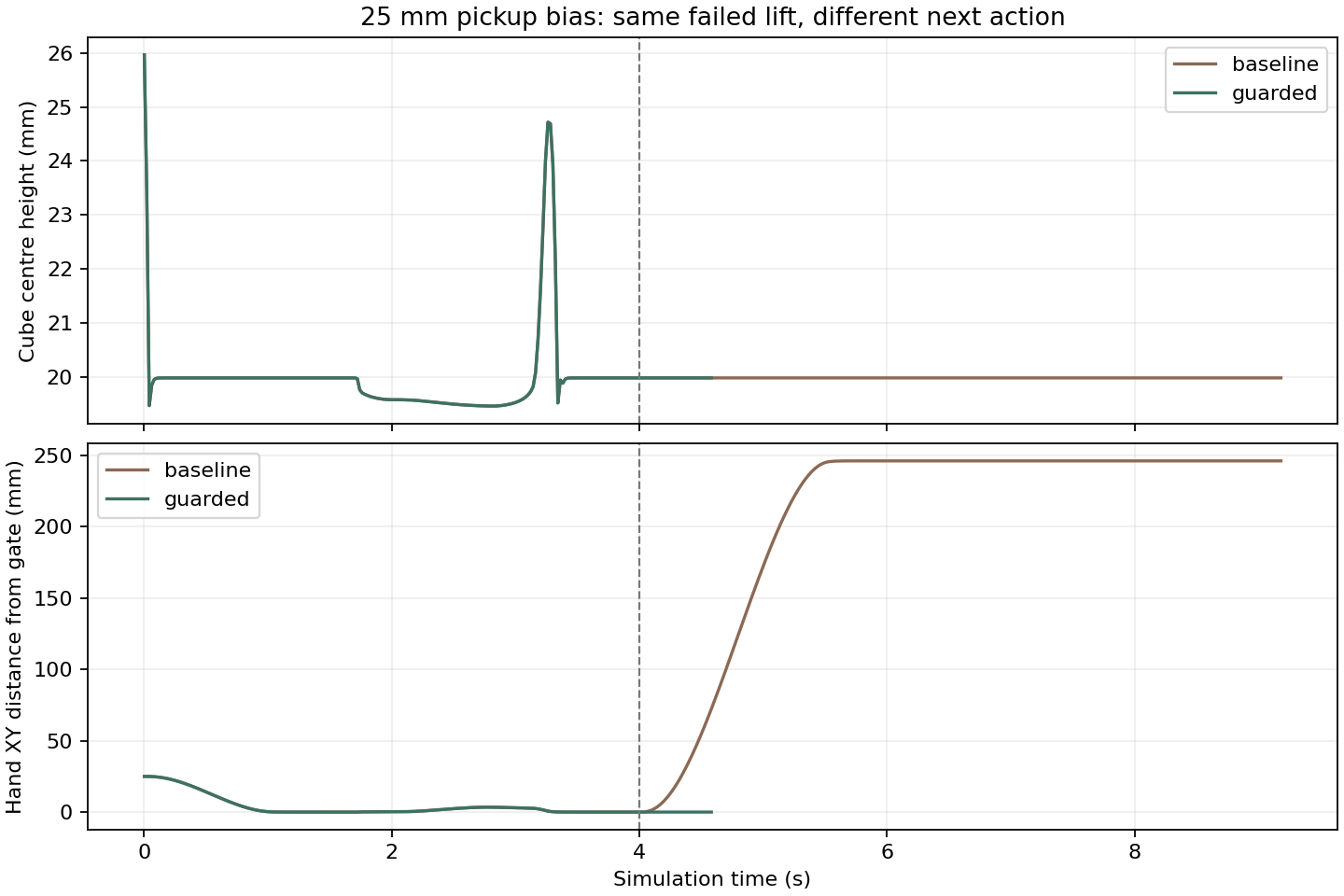
The plot uses the first 25 mm pair's CSV. The top panel shows cube-centre height; the bottom shows horizontal distance from the gripper's position near the gate. The dashed line is 4 s. Displacement in the plot differs from accumulated path in the table; these paths are almost straight, so their final values are close.
6. Watch the two continuations of the same failed pickup
Original sequence: the cube stays behind while the empty gripper moves toward the bin.
With the gate: the lift check fails, the gripper holds its current targets, and the episode ends.
Both are actual 25 FPS recordings. The evidence directory contains all other states, screenshots and recordings.
7. Reproduce and diagnose
Use the original Python 3.12 / MuJoCo 3.3.7 environment. From the independent repository root:
.venv/Scripts/python.exe -m unittest discover -s experiments/vl01_grasp_guard -p "test_*.py"
.venv/Scripts/python.exe experiments/vl01_grasp_guard/run.py --out evidence/my-guard-run --render
.venv/Scripts/python.exe experiments/vl01_grasp_guard/audit.py evidence/my-guard-run
The output directory must not exist. manifest.json records the source commit, hashes and runtime versions. Each episode includes trajectory.csv, states.jsonl, events.json and summary.json. Eight unit tests cover valid grasps and boundaries including one-sided contact, threshold height, stale/empty history, duplicate/reordered samples, transient contact, future observations and non-finite height.
When rejected, inspect gate.reasons, window_start/window_end, min_cube_z_m and both_pad_samples rather than only the success flag.
Saved states can be replayed:
.venv/Scripts/python.exe experiments/vl01_grasp_guard/replay.py evidence/grasp-guard-20260929/guarded-025mm-run-1/states.jsonl --out outputs/guard-replay.mp4Replay restores recorded qpos/qvel/ctrl; it does not rerun the policy and is not another independent trial.
8. What remains before a real closed-loop robot?
The gate reads simulator body positions and contact pairs: privileged state observations. Real hardware would need visual estimates, gripper width, motor current or force sensing, each with noise, delay and missing data.
Three gaps remain:
- The check happens once before transfer. A later slip is not detected.
- There is no regrasp or recovery planning. A rejected task remains failed.
- Two biased conditions in one fixed scene cannot establish false-positive rates, false-negative rates or robustness.
The useful principle is to verify the facts that the next action depends on. The next test should introduce a reproducible slip during transport and compare ongoing monitoring before adding recovery.
A note to your future selfBefore you move on, keep one thought of your own.
Your private reading note stays in this browser; it is never uploaded or published. Clearing browser data removes it, so export a copy to keep. This article’s translations share the same note.
KEEP EXPLORING
Related content
- Tutorials
Embodied AI Practice I: Pick up a cube in MuJoCo, then deliberately miss
Run a contact-based pick-and-place task, compare0,25 and50mm target biases, and preserve videos, state trajectories and explicit success criteria.
- PROJECT / 003
Hohoo Embodied Experiments
Seven MuJoCo teaching experiments, from pickup bias to stage contracts, with raw trajectories, decisions and independent audits.
- LAB / 006
E2 / Confirm the grasp before transfer
Use sustained height and bilateral contact to decide whether transfer should proceed.
Which way next?
- Embodied AI Practice I: Pick up a cube in MuJoCo, then deliberately miss →
Run a contact-based pick-and-place task, compare0,25 and50mm target biases, and preserve videos, state trajectories and explicit success criteria.
Based on article relationships and published same-topic content, not random recommendations.