PROJECT / 003
Hohoo Embodied Experiments
Seven MuJoCo teaching experiments, from pickup bias to stage contracts, with raw trajectories, decisions and independent audits.
OVERVIEW
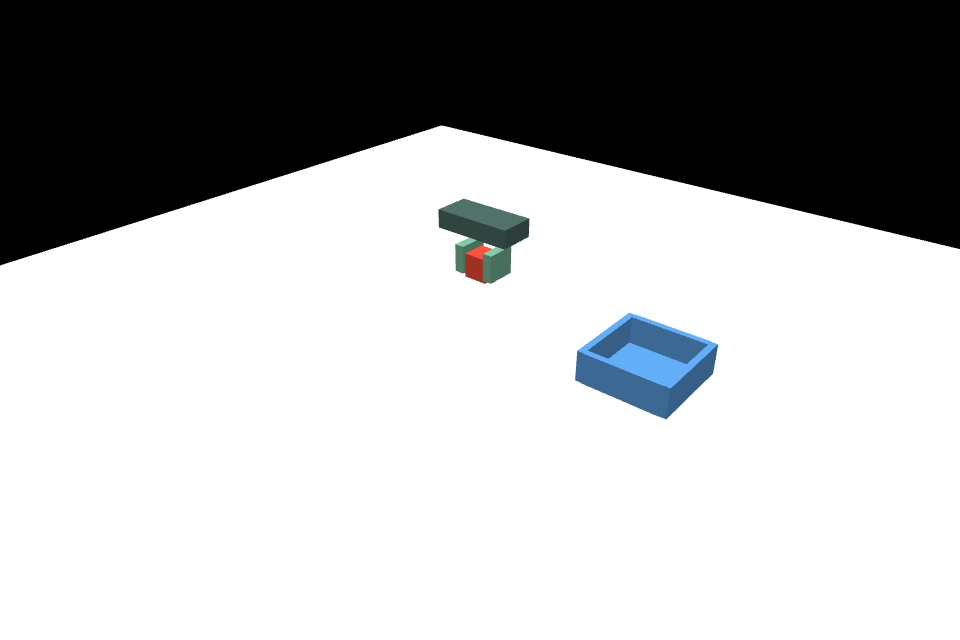
Seven experiments cover pickup bias, grasp gating, monitoring, freshness, recovery, gate/path ablation and lowering contracts. Each archives its protocol and raw data from a shared gripper scene.
GOAL
Distinguish commands, phase conditions and task completion through controlled comparisons of failure responses.
ARCHITECTURE
Scene and frozen protocol → actuator targets → MuJoCo steps → state/contact records → success checks → video and trajectory audit.
VALIDATION
Seven rounds contain 9, 18, 27, 45, 18, 30 and 21 rollouts; E6 also has 18 E5 regressions. E7 passes 21 tests and audits 105 episode files, 10 source fingerprints and 21 prefixes. No generalized success rate.
LIMITATIONS
Privileged simulation observations and one clock. Recovery requires renewed communication and a retained grasp. No regrasp, vision, ROS2 bridge, learned policy or physical validation; M4/M5 remain incomplete.
Code and companion reading
First practice article →
Pick up a cube in MuJoCo, then deliberately miss
Scene and reproduction code →
Frozen protocol, controller, tests and replay
All nine recorded episodes →
CSV, states, videos, screenshots and plots
Follow-up: stop empty transfer →
18 rollouts, raw CSV, six recordings and an independent audit
Practice III: monitor during transfer →
27 rollouts: false cancellations, a 40 ms confirmation delay and measured trajectory replays
Practice IV: freshness and sampling →
45 rollouts: counts, elapsed evidence and expired observations
E5 / Revalidate before resuming →
18 rollouts · replay-driven cycling · new evidence and replanning
Practice VI: gate/path ablation →
30 rollouts · target jumps · the monitoring scope behind 72 resumptions
E6 code and raw evidence →
30 ablation and 18 regression runs; original execution and independent revalidation
Practice VII: lowering contracts →
21 rollouts · clean-run false alarm · residual contact after stopping
Complete E7 evidence →
Frozen code, per-step control logs, states, full matrix and independent auditing
KEEP EXPLORING
Related content
- Tutorials
Embodied AI Practice I: Pick up a cube in MuJoCo, then deliberately miss
Run a contact-based pick-and-place task, compare0,25 and50mm target biases, and preserve videos, state trajectories and explicit success criteria.
- Mechanisms
Reading OpenVLA — from an image and instruction to robot actions
Follow preprocessing, visual projection, action tokens and unnormalization, with particular attention to units, boundary indices and the environment interface.
- Engineering cases
Embodied practice II: if the grasp failed, skip the transfer
An 18-rollout MuJoCo comparison of a lift/contact gate, with recorded trajectories, videos, runnable code and explicit limits.
- Engineering cases
Embodied practice III: a confirmed grasp still needs monitoring
A 27-rollout MuJoCo comparison of transient observation loss and forced opening, with false cancellations, a 40 ms confirmation delay, code and recorded trajectories.
- Engineering cases
Embodied practice IV: messages arrive, but observations expire
45 MuJoCo rollouts separate sampling intervals, bad-sample counts and capture age, showing how old messages can hide grip loss and why duration thresholds still have limits.
- Engineering cases
Embodied practice 5: communication is back—may transfer resume?
18 MuJoCo rollouts reveal unsupported resumptions hidden by eventual success; validate fresh evidence and replan the remaining path.
- LAB / 009
E5 / Revalidating recovery
Does delivery recovery authorize the old action? Compare fresh evidence, replay and remaining-path planning.
- Engineering cases
Embodied AI VI: what do recovery gating and replanning each solve?
A 30-rollout ablation reduces first target jumps from 50–97 mm to about 0.25 mm, without improving placement outcomes in this fixed matrix. Separate recovery evidence, command continuity and task success.
- LAB / 012
E6 / Recovery gate and path ablation
Separate revalidation from replanning: which differences concern evidence and which concern the resumed target?
- Engineering cases
Embodied AI Practice VII: Why a Transfer Rule Stops Normal Lowering
21 MuJoCo rollouts separate stage-specific grasp checks, stop actions and final placement. A false alarm and lingering finger contact reveal two different failure modes.
- LAB / 013
E7 / Grasp contracts during lowering
What changes when transfer monitoring extends into lowering?