Learn / Practice
Embodied practice 5: communication is back—may transfer resume?
EMBODIED-AI · Engineering cases
18 MuJoCo rollouts reveal unsupported resumptions hidden by eventual success; validate fresh evidence and replan the remaining path.
View count unavailable
On this page 10
The previous experiment detected stale observations and stopped transfer. The next question is whether communication recovery authorizes an old action to continue.
The revealing result is a counterexample: the receipt-only policy resumed nine times while an old good packet was replayed. Eight resumptions lacked fresh grasp evidence, yet placement eventually succeeded. An endpoint-only score hides the repeated interruptions.
Code and reproduction · Raw evidence and plots · Independent audit
1. Stopping and resuming require different evidence
A communication gap may leave the cube firmly grasped, or conceal a real drop. Transport recovery does not establish the task precondition.
We ask three questions: is this a new observation; does it continuously support a valid grasp; and is the old time-indexed path still appropriate? The first two authorize recovery. The third determines the next command.
2. Frozen setup
The same Cartesian gripper, cube, tray and original motion run in Python 3.12.14, MuJoCo 3.3.7 and NumPy 2.2.6. Commit 8142cdb froze the protocol before the formal run.
| Parameter | Value |
|---|---|
| Physics and control | 2 ms |
| Capture period | 20 ms |
| Fault onset | 4.8 s, during transfer |
| Delivery gap | [4.8, 5.04), 240 ms |
| Stale threshold | Age reaches 60 ms |
| Bad-evidence threshold | Span reaches 40 ms |
| Recovery confirmation | At least 100 ms |
| Hold deadline | 600 ms after stopping |
| Shared horizon | 10.8 s |
| Matrix | Six conditions × three policies = 18 rollouts |
There is one deterministic run per cell, not 18 independent random trials or an estimate of deployment success. Observations are privileged simulator state, not visual perception.
3. Six conditions
| Condition | Intervention |
|---|---|
| clean | No disturbance |
| delay-40ms | Every capture arrives 40 ms late |
| reordered | Every third post-onset packet arrives 80 ms late |
| gap | Suppress delivery during the gap; resume new captures without backlog |
| stale-replay | After the gap, replay the last good old packet until 5.2 s |
| gap-and-drop | Open the gripper during the same communication gap |
Opening changes actuator commands; contact and gravity move the cube. Its position is not teleported. Delay and reordering do not force an alarm: remaining in motion is itself a result.
4. Three recovery policies
Latched: keep the held target and abort after 600 ms, without resuming.
Receipt-only: any valid delivered packet resumes the original wall-clock path, even when duplicate, stale or inconsistent with a grasp. This is an intentionally weak baseline.
Revalidate: require strictly increasing captures made after the stop; age below 60 ms; bilateral contact; cube height above 0.12 m; cube-to-gripper distance below 0.05 m; and at least 100 ms of evidence with adjacent captures no more than 20 ms apart. A failed condition resets the window.
At the 600 ms deadline, abort takes precedence over confirmation on the same tick. These thresholds belong to this teaching scene, not a universal robot safety specification.
5. Why replay causes repeated stop–resume cycles
The following times come from the stale-replay logs:
| Time | Event |
|---|---|
| 4.782 s | Last pre-gap good capture |
| 4.842 s | Its age reaches 60 ms and transfer stops |
| 5.042 s | Receipt-only resumes on that same capture, now 260 ms old |
| Afterwards | Staleness stops motion again; another delivery reopens it |
| 5.302 s | Revalidation first resumes after 100 ms of fresh evidence |
Receipt-only resumes nine times, eight on stale evidence. Inspect recovery events together with the final task outcome.
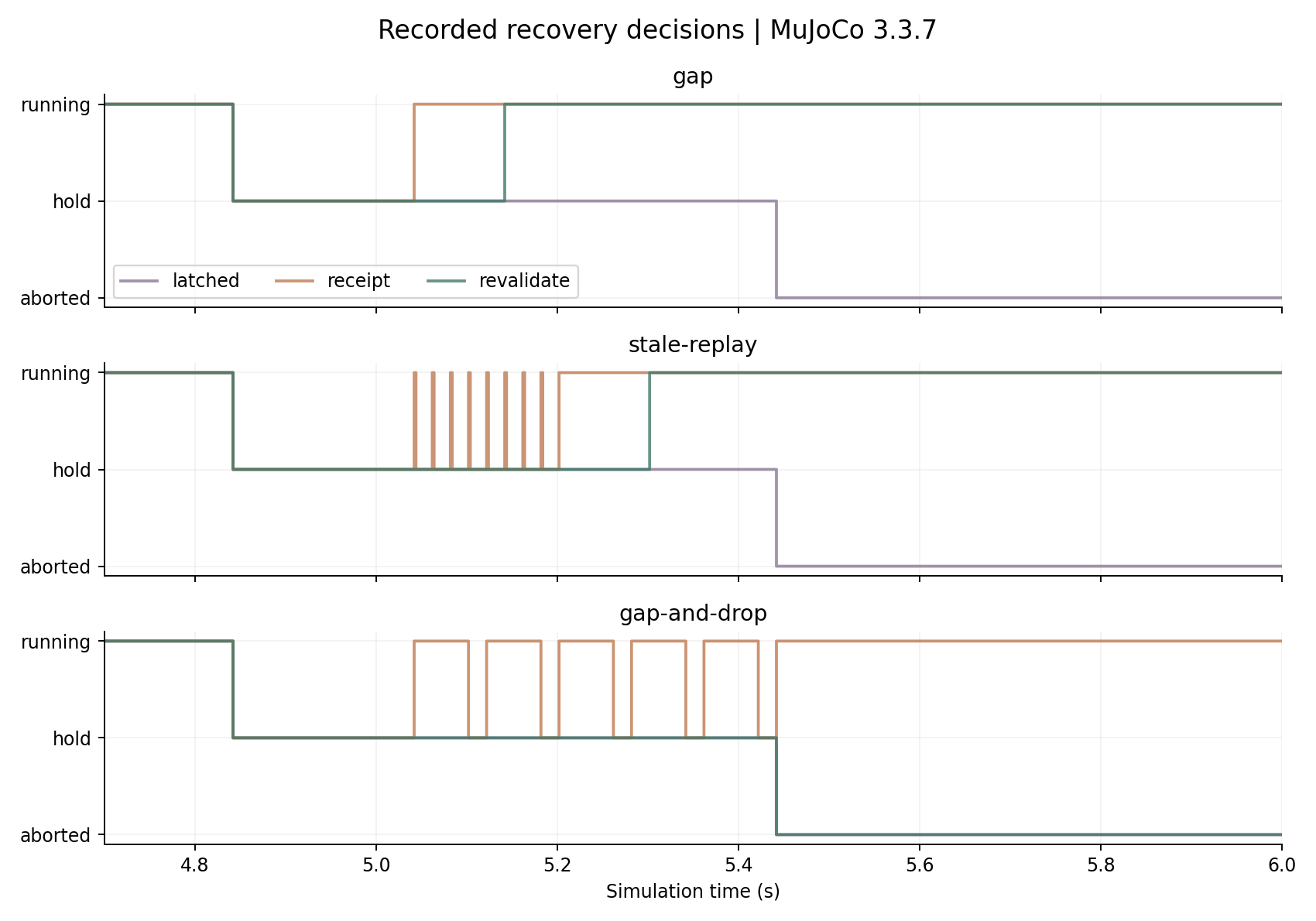
This plot comes from control logs. It is neither a camera image nor a physical robot recording.
6. Why replan the remaining path?
Physics and the clock keep advancing while a target is held. Looking up the old path at the current wall-clock time can skip an unexecuted segment.
Revalidation creates a 1.5 s transfer from the current measured gripper position to the original transfer destination, followed by the original lowering, release, retreat and settling stages. Holding a target does not freeze physical state.
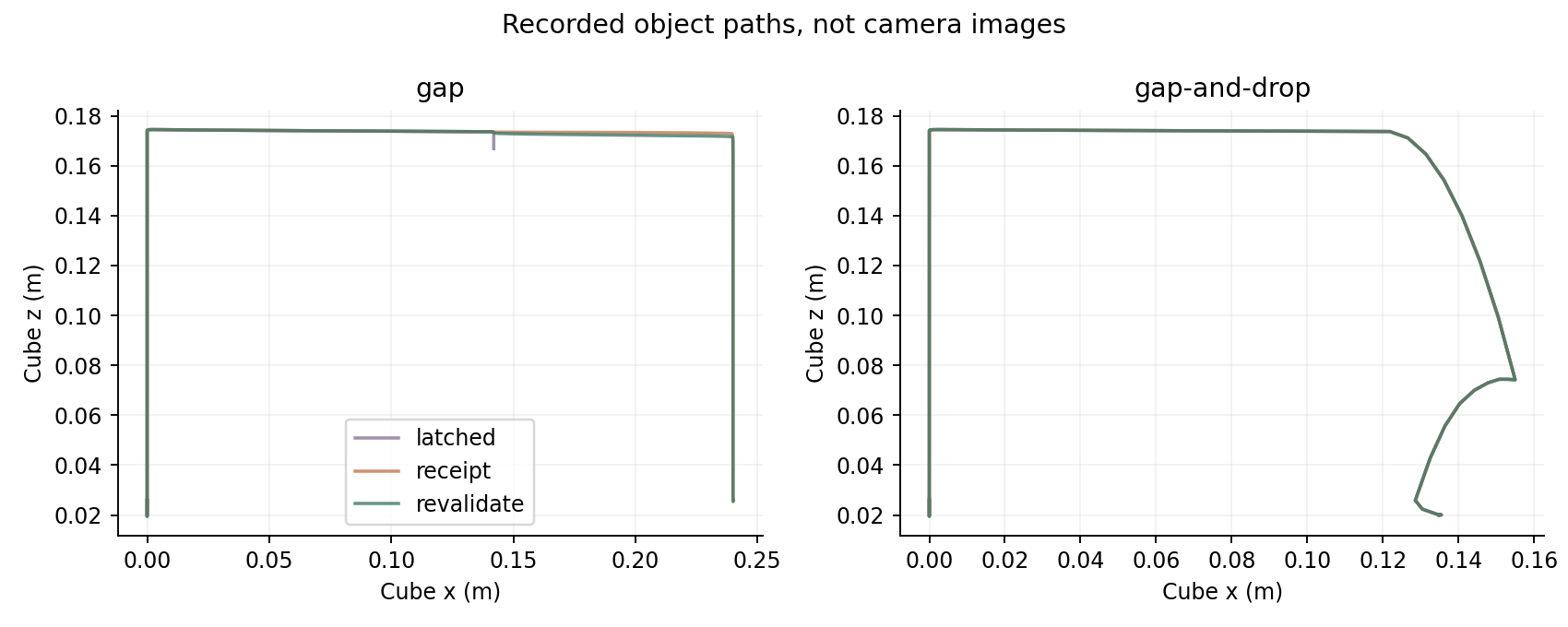
The policy changes both authorization and trajectory generation. This comparison therefore evaluates a bundle. A separate ablation would be needed to attribute differences to the 100 ms gate alone.
7. All 18 outcomes
| Condition | Latched | Receipt-only | Revalidate |
|---|---|---|---|
| Clean | Placement succeeds | Succeeds | Succeeds |
| Fixed 40 ms delay | Succeeds | Succeeds | Succeeds |
| Every third packet 80 ms late | Succeeds | Succeeds | Succeeds |
| 240 ms gap | Aborts, no placement | One resume, succeeds | One resume, succeeds |
| Stale good replay | Aborts, no placement | Nine resumes, eight unsupported; succeeds | One resume, succeeds |
| Gap and forced opening | Aborts, no placement | Six unsupported resumes; fails placement | No resume, aborts |
“Unsupported” means capture age at least 60 ms or a false grasp predicate at resumption. It is not a claim that a physical robot would necessarily become unsafe.
Revalidation resumes at 5.142 s for the plain gap and 5.302 s for stale replay. After forced opening, it aborts at 5.442 s. Failing placement in the latter case is compatible with correctly refusing an unjustified continuation.
8. Checks independent of the decision class
The audit reads saved CSV/state files without calling Gate:
- It recomputes endpoint outcomes for 18 rollouts.
- Twelve policy prefixes before their first decision divergence match exactly: maximum absolute qpos/qvel/ctrl error is zero.
- Both revalidation windows satisfy ordering, age, duration and grasp predicates.
- It records SHA-256 for 108 raw files and checks packet accounting and deadlines.
- Eighteen new boundary tests and 41 existing tests pass.
This checks evidence consistency and logic boundaries; it is not validation against another physics engine.
9. Reproduce and inspect
From the embodied repository, use a new output directory:
.venv/Scripts/python experiments/vl01_recovery_gate/test_gate.py
.venv/Scripts/python experiments/vl01_recovery_gate/run.py --out evidence/my-recovery-run
.venv/Scripts/python experiments/vl01_recovery_gate/audit.py evidence/my-recovery-run
.venv/Scripts/python experiments/vl01_recovery_gate/render.py evidence/my-recovery-run
Each control.csv records decisions every 2 ms. State and trajectory samples are saved every 20 ms. Events record stops/resumes/aborts; replans record new starting states.
For historical evidence checked out on another platform, run portable-audit.py evidence/recovery-20260930. It restores only an LF/CRLF representation matching the recorded hash in a temporary directory, then runs the frozen audit. Original evidence remains unchanged.
10. Limits and the next question
Within these fixed conditions, delivery alone is insufficient authorization. Sustained new grasp evidence plus remaining-path planning separates communication interruption from lost grasp.
Real networks, clock skew, vision error, different objects and different fault phases remain untested. This is not regrasping, a ROS2 bridge or completion of M4/M5. The next useful experiment is an ablation separating the gate from replanning.
For simulator stepping and state basics, see the MuJoCo 3.3.7 simulation documentation. The code, frozen protocol and raw logs define the scope of this article.
A note to your future selfBefore you move on, keep one thought of your own.
Your private reading note stays in this browser; it is never uploaded or published. Clearing browser data removes it, so export a copy to keep. This article’s translations share the same note.
KEEP EXPLORING
Related content
- Engineering cases
Embodied practice IV: messages arrive, but observations expire
45 MuJoCo rollouts separate sampling intervals, bad-sample counts and capture age, showing how old messages can hide grip loss and why duration thresholds still have limits.
- Engineering cases
Embodied practice III: a confirmed grasp still needs monitoring
A 27-rollout MuJoCo comparison of transient observation loss and forced opening, with false cancellations, a 40 ms confirmation delay, code and recorded trajectories.
- LAB / 009
E5 / Revalidating recovery
Does delivery recovery authorize the old action? Compare fresh evidence, replay and remaining-path planning.
- PROJECT / 003
Hohoo Embodied Experiments
Seven MuJoCo teaching experiments, from pickup bias to stage contracts, with raw trajectories, decisions and independent audits.
Which way next?
- Embodied practice IV: messages arrive, but observations expire →
45 MuJoCo rollouts separate sampling intervals, bad-sample counts and capture age, showing how old messages can hide grip loss and why duration thresholds still have limits.
- Embodied practice III: a confirmed grasp still needs monitoring →
A 27-rollout MuJoCo comparison of transient observation loss and forced opening, with false cancellations, a 40 ms confirmation delay, code and recorded trajectories.
Based on article relationships and published same-topic content, not random recommendations.