

Learn / Practice
MuJoCo observation loss: zero force is not a stop
EMBODIED-AI / EXPLORE · Engineering cases
Compare stale feedback, zero force and fading in 27 episodes to distinguish timeout from physical braking.
What was published after this article?
The original conclusions and next-step proposals are retained. These published follow-ups do not imply that every limitation has been resolved.
KEEP EXPLORING
Related content
- Engineering cases
MuJoCo mass transfer: can the same gains still work?
Compare fixed and mass-scaled gains in 36 episodes, including lower mean error without a velocity-contract pass.
View count unavailable
On this page 6
Reproduce from a clean checkout · this article’s revision
Windows PowerShell with Python 3.12. Use a new directory, not a working copy with unsaved changes. Each article pins its own revision; the first article’s revision does not contain later experiments.
git clone https://github.com/VirtualSelect/hohoo-embodied-agent.git hohoo-embodied-agent-study
cd hohoo-embodied-agent-study
git checkout 1d1faab57e20b352761e9abc736c6d277b505e6b
python -m venv .venv
$py = '.\.venv\Scripts\python.exe'
& $py -m pip install -r requirements-lock.txt
& $py experiments/planar_reliability/run.py --out outputs/my-run
& $py experiments/planar_reliability/audit.py outputs/my-run
Expect raw trajectories, summaries and audit results. Use a new output directory to preserve earlier results; runners differ in how they handle existing directories. E8–E10 share one experiment runner. No model calls are made; run the numeric experiment first and use the article’s separate replay command for video.
Troubleshooting: a missing experiment directory usually means the wrong revision; import failures require checking the interpreter and environment. OpenGL errors concern rendering steps. On Linux/macOS use .venv/bin/python; those platforms have not been retested.
Inspect the pinned code ↗Pinned code · Archived evidence · Study protocol
Communication stops while the controller continues using its last position and velocity estimate. Does commanding zero force constitute a safe stop? In this frictionless planar model, zero force means no further acceleration, not zero velocity.
Using the development-selected parameters, this experiment compares three stale-observation policies. MuJoCo advances every physical state; nothing teleports the actuator or clears its velocity to manufacture a stop.
Which clock detects staleness?
Each sample carries capture time and becomes usable only after arrival. Age is decision time minus capture time. Reusing the same sample cannot refresh its age.
sample -> 40 ms delay queue -> arrived observation -> estimate/control
                                    |
                           now minus capture time
Delay is 40 ms, position noise 3 mm, control period 20 ms and physics step 2 ms. Policies activate strictly above 100 ms; the exact boundary remains normal control. Conditions are normal delivery, dropped captures from 0.4 to 1.0 seconds, and permanent loss after 0.4 seconds. Three seeds, conditions and policies give 27 episodes.
Noise is drawn even for dropped samples, then discarded. This preserves matching random-number consumption across policies and dropout conditions.
Three policies change different commands
| Policy | Age at most 100 ms | Older observation |
|---|---|---|
| hold | PD and force clipping | Continue PD from last observation |
| zero | PD and force clipping | Command zero force |
| fade | PD and force clipping | Linearly reduce clipped force, reaching zero at 200 ms |
Hold does not hold the current physical position: it keeps a stale control computation. The actuator moves while the observed error remains fixed, potentially driving sustained acceleration.
Zero and fade are not closed-loop braking. They add no fresh speed information, friction or brake model. The implementation never clears qvel to obtain a stationary picture.
Temporary loss and permanent loss differ
The following values average final-300ms position RMS over three seeds, in millimetres:
| Communication | hold | zero | fade |
|---|---|---|---|
| Normal | 2.04 | 2.04 | 2.04 |
| Burst loss, 0.4–1.0 s | 2.02 | 2.06 | 2.05 |
| Permanent loss after 0.4 s | 16,025.96 | 2,748.98 | 2,370.92 |
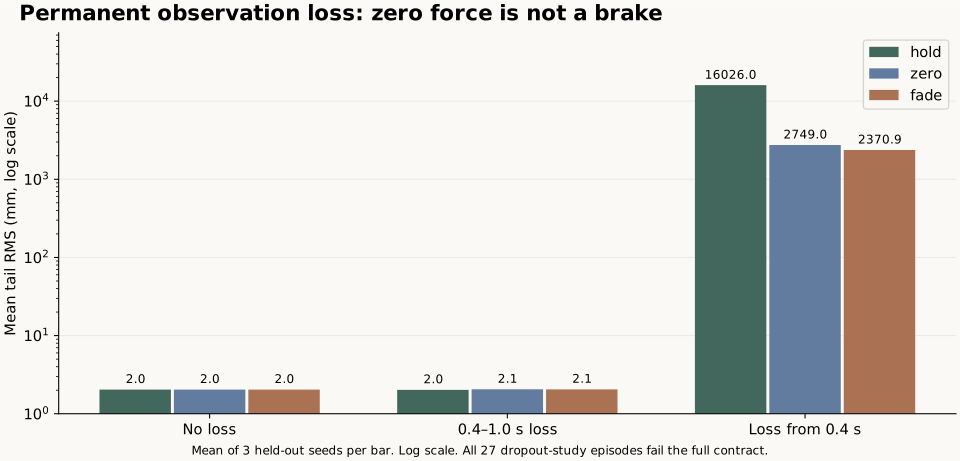
Normal results match because age never triggers the policies. After temporary loss, new observations allow low terminal position error again; terminal averages do not describe the intermediate path.
With permanent loss, hold keeps pushing, zero permits momentum-driven coasting, and fade changes force withdrawal without guaranteeing braking. None of the 27 episodes passes the full position-and-speed contract, including normal episodes with small position error. There is no safety winner in this table.
Why retain such a simple counterexample?
Sending a zero command, stopping controller software, entering actuator braking mode and confirming a stationary object are different events. Verifying only the first cannot justify the fourth. Hardware systems also require actuator semantics, watchdogs, gravity/contact handling, brakes and appropriate safety validation; none is present here.
The 100/200 ms thresholds are teaching parameters, not safety standards. Mass, initial velocity, target and failure phase alter displacement. Testing one loss onset cannot establish a worst-case stopping distance.
Read the trace
For permanent loss under zero, locate the first zero fx/fy row and inspect subsequent vx/vy. Velocity persists in this undamped model; the independent F=m*a check verifies it. An immediate stop suggests state clearing or additional damping in the scene.
For burst loss under fade, inspect capture times after recovery: receiving an old sample again is not fresh sensing. A future braking design must specify available observations and actuator capabilities rather than secretly reading simulator truth to replace missing sensors.
Reproduce the protocol
Run from a fresh checkout in PowerShell. The output directory must not exist. All three articles in this study share one frozen protocol; run it once and inspect the section relevant to each article.
git clone https://github.com/VirtualSelect/hohoo-embodied-agent.git hohoo-embodied-agent-study
cd hohoo-embodied-agent-study
git checkout 1d1faab57e20b352761e9abc736c6d277b505e6b
python -m venv .venv
$py = '.\.venv\Scripts\python.exe'
& $py -m pip install -r requirements-lock.txt
& $py -m unittest discover -s experiments/planar_reliability -p "test_*.py"
& $py experiments/planar_reliability/run.py --out outputs/reliability-my-run
& $py experiments/planar_reliability/audit.py outputs/reliability-my-run
Tested on Windows with Python 3.12.14 + MuJoCo 3.3.7 + NumPy 2.2.6; 3 unit tests, 153 episodes and 306000 rows. The independent audit should print PASS. Other operating systems have not been rechecked. To inspect the archived result without rerunning the experiment, pass evidence/planar-reliability-20261011 to the same audit command. Source hashes normalize LF; evidence hashes use original bytes. Do not rewrite the manifest to conceal a mismatch.
If an import fails, verify that installation and execution use the same $py. Preserve failed outputs and choose a new directory for reruns. Numeric comparisons use the frozen tolerances; timing is a local measurement, not a required speed threshold.
Code and writing are AI-assisted; the findings are limited to the archived, auditable runs. No new paid model requests were made, and this does not claim author-performed manual review.
A note to your future selfBefore you move on, keep one thought of your own.
Your private reading note stays in this browser; it is never uploaded or published. Clearing browser data removes it, so export a copy to keep. This article’s translations share the same note.
Next published article:MuJoCo mass transfer: can the same gains still work? →
You are here
EXPLORE / Getting started with embodied AI
- ○ MuJoCo controller tuning: best candidate is not a passing controller
- ○ MuJoCo observation loss: zero force is not a stop
- ○ MuJoCo mass transfer: can the same gains still work?
KEEP EXPLORING
Related content
- LAB / 044
Planar control tuning, observation loss and transfer
153 episodes and 306000 physics steps. The selected controller passes 7/18 holdouts; zero force coasts, and mass scaling lowers mean error without passing the velocity contract.
- PROJECT / 003
Hohoo Embodied Experiments
Two MuJoCo teaching scenes—pick-and-place and planar force control—record contracts, tuning, clearance and delayed-feedback outcomes, including failures.
Which way next?
- MuJoCo controller tuning: best candidate is not a passing controller →
Select on 54 development episodes, then check position error and stable completion on 36 held-out episodes.
Based on article relationships and published same-topic content, not random recommendations.