

Learn / Practice
KV quantization axes: why Key and Value need separate reasoning
llm / UNDERSTAND · Mechanisms
162 archived INT8 comparisons examine tensor, token and K-channel/V-token scales, including cases where the hybrid loses.
What was published after this article?
The original conclusions and next-step proposals are retained. These published follow-ups do not imply that every limitation has been resolved.
KEEP EXPLORING
Related content
- Mechanisms
Packed KV groups: what does 4-bit actually save?
Store real nibbles and audit group-scale overhead, padding bytes and attention output error.
View count unavailable
On this page 5
Reproduction correction, 2026-10-11: Git newline conversion in the original pinned commit
009289dchanged the bytes ofresults.json, breaking its checkout-time hash audit. Links and checkout commands below now use the byte-preserving fix. The measurements, publication date and conclusions are unchanged.
Pinned code · Inputs, integer codes and outputs · Lab
The previous article showed that per-row INT8 shrinks KV storage but leaves small elements vulnerable to a large element in the same row. Is per-channel quantization always better? It depends on the distribution of outliers. An axis is not a universal recommendation.
These are fixed synthetic arrays, saved integer codes, scales and attention outputs, not a trained-model evaluation. There are no Agnes calls, model weights, GPU kernels or throughput measurements.
What rows and columns mean
K and V have shape N × D: N token rows and D feature channels. Every method uses the same symmetric rule:
scale = max(abs(group)) / 127
code  = clip(round(x / scale), -127, 127)
x_hat = code * scale

Tensor: one scale for the whole matrix
Token:  one scale per row, N scales
Channel: one scale per column, D scales
If one channel is large across many tokens, it enlarges every per-token scale, reducing resolution for small channels. Per-channel grouping isolates that column. Conversely, if one token row is large, per-token grouping isolates that row while per-channel scales all grow.
This is a testable mechanism, not a claim that real model distributions have these idealized shapes. KIVI discusses K/V distributions and differing granularities. This experiment borrows the question, not its grouping, asymmetric 2-bit scheme, residual cache or model-quality conclusions.
Separate the two error paths
K error -> QKᵀ / √D -> changed Softmax weights -> output
V error -----------------------------------> weighted sum
K changes where attention goes; V changes the values it aggregates. We therefore quantize K-only, V-only and both. Attention uses stable Softmax in float64. The source and unquantized storage baseline are float32; their byte counts must not be confused with the calculation precision.
The frozen protocol uses seeds 7, 19 and 41; lengths 64 and 256; D=32; eight query rows. Each base input has three conditions: clean, K column 0 multiplied by 40, or V row 0 multiplied by 40. The conditions reuse the same base arrays. Three schemes and three quantization targets produce 18 inputs and 162 output comparisons.
The hybrid wins one condition and loses others
Relative error is ||output - reference||₂ / ||reference||₂. Each table cell is the arithmetic mean of six individually calculated errors (three seeds × two lengths), expressed as a percentage. It is neither the error of an averaged output nor a task-accuracy metric.
| Both K/V quantized | Tensor | Token for both | K-channel / V-token |
|---|---|---|---|
| Clean | 1.2067 | 0.8006 | 0.8818 |
| K-channel outlier | 13.9727 | 7.9781 | 1.9215 |
| V-token outlier | 8.9957 | 0.7364 | 0.8106 |
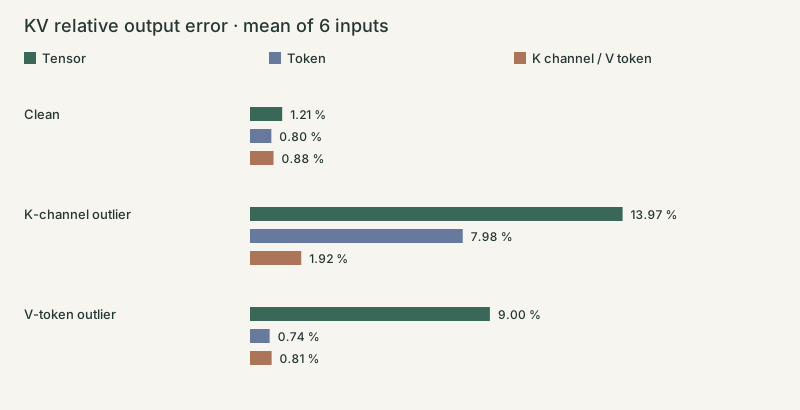
With K-only quantization, the K-channel-outlier errors are 13.9658%, 7.9645% and 1.7653%. That supports the local explanation of isolating high-amplitude channels. For V-only quantization under a V-row outlier, tensor error is 8.9198%, while token and hybrid both give 0.5427%: their V rules are identical.
The hybrid does not beat token-for-both on clean or V-row-outlier inputs. There is no basis here for calling it more universal. Nor should every output error be blamed on Softmax without decomposition; the K-only/V-only results limit that explanation.
Scales occupy bytes too
This counts numeric KV payload including float32 scales, excluding object headers, allocators and workspaces.
| N | Float32 K/V | Tensor INT8 | Token for both | K-channel / V-token |
|---|---|---|---|---|
| 64 | 16,384 B | 4,104 B | 4,608 B | 4,480 B |
| 256 | 65,536 B | 16,392 B | 18,432 B | 17,536 B |
The hybrid formula is 2ND + 4D + 4N bytes. At N=256 it reduces cache-array bytes by 73.24%, not exactly 75%. The compressed arrays.npz archive repeats some arrays for auditing; its file size is not a deployed inference cache size.
This implementation restores INT8 to float64 before multiplication. It establishes representation size and local numerical error, not lower peak memory or faster generation. Dequantization and allocation might offset gains in a decoding loop. This round did not time that path and reports no speedup.
Reproduce
The following commands use Windows PowerShell and explicitly select the virtual-environment interpreter.
git clone https://github.com/VirtualSelect/hohoo-ai-lab.git hohoo-ai-lab-study
cd hohoo-ai-lab-study
git checkout fd8102724ee8dcf45cfa55fe580cbbc6fcefd7ba
python -m venv .venv
$py = '.\.venv\Scripts\python.exe'
& $py -m pip install -r experiments/11-kv-quantization-axes/requirements.txt
& $py -m unittest discover -s experiments/11-kv-quantization-axes -p "test_*.py"
& $py experiments/11-kv-quantization-axes/run.py --out experiments/11-kv-quantization-axes/target/my-run
& $py experiments/11-kv-quantization-axes/audit.py experiments/11-kv-quantization-axes/target/my-run
Windows, Python 3.12.14 and NumPy 2.2.6 were tested; other platforms were not. Expect four passing unit tests, 162 saved comparisons and PASS: 162 archived comparisons.... The audit does not import the implementation's attention function: it restores archived codes/scales and independently expresses the calculation with NumPy to check outputs, errors and bytes.
If scales have the wrong shape, check the reduction axis: token scales are (N,1) and channel scales (1,D). A zero group uses scale 1 to avoid division by zero. NaN/Inf inputs are rejected. After source changes, run into a new directory rather than editing the old manifest to suppress mismatches.
Exercise: change V to a column outlier and predict whether token grouping still isolates it. Freeze and save this as a new condition. Real-model work still needs actual K/V distributions, grouping choices, task quality, dequantization cost and measured memory. Random arrays cannot replace those validations.
A note to your future selfBefore you move on, keep one thought of your own.
Your private reading note stays in this browser; it is never uploaded or published. Clearing browser data removes it, so export a copy to keep. This article’s translations share the same note.
Next published article:Packed KV groups: what does 4-bit actually save? →
You are here
UNDERSTAND / LLM
- ○ KV quantization: how many bytes, and at what error?
- ○ KV quantization axes: why Key and Value need separate reasoning
- ○ Packed KV groups: what does 4-bit actually save?
KEEP EXPLORING
Related content
- LAB / 040
KV quantization axes: why Key and Value need separate reasoning
162 archived INT8 comparisons examine tensor, token and K-channel/V-token scales, including cases where the hybrid loses.
- PROJECT / 002
Java LLM Practice
Reproducible Java conversation, retry and persistence boundaries, alongside attention, cache-cost and quantization-error experiments.
- Mechanisms
Tiled attention: preserving results without a full score matrix
Derive online softmax from a failing block-average baseline and separate smaller temporaries from measured speed.
Which way next?
- KV quantization: how many bytes, and at what error? →
Compare tensor and row-wise int8 quantization, including scale bytes and attention error under outliers.
- Tiled attention: preserving results without a full score matrix →
Derive online softmax from a failing block-average baseline and separate smaller temporaries from measured speed.
Based on article relationships and published same-topic content, not random recommendations.