

Learn / Practice
Packed KV groups: what does 4-bit actually save?
llm / UNDERSTAND · Mechanisms
Store real nibbles and audit group-scale overhead, padding bytes and attention output error.
What was published after this article?
The original conclusions and next-step proposals are retained. These published follow-ups do not imply that every limitation has been resolved.
KEEP EXPLORING
Related content
- Mechanisms
KV residual windows: do recent tokens deserve higher precision?
Compare early-focused and recent-focused attention to explain unequal gains from the same float32 window.
View count unavailable
On this page 6
Pinned code · Archived evidence · Study protocol
The previous experiment compared quantization axes but stored int8. Calling a value “4-bit” does not halve storage if every value still occupies a uint8. Bit width, packing and scale overhead require separate accounting.
This implementation packs two nibbles per byte and compares group sizes 8/32 and bit widths 4/8. Inputs are fixed synthetic arrays, not KV collected from a trained model.
What occupies one byte?
Symmetric 4-bit quantization uses signed values [-7,7] and a per-group scale max(abs(x))/7. Adding 7 maps codes to [0,14]; 15 is unused.
packed = codes[0::2] | (codes[1::2] << 4)
low = packed & 15
high = packed >> 4
For example, codes 2 and 13 form hexadecimal D2; subtracting 7 reconstructs -5 and 6 before scaling. This is not two's-complement int4 or a learned codebook. Decoding restores shape and removes padding.
The 8-bit comparison similarly shifts [-127,127] into unsigned bytes. Both retain float32 scales and two int32 shape dimensions, included in the payload totals.
Direction and group length both matter
K is N×D: each channel is grouped across consecutive Tokens. V is grouped across features within each Token.
K: fixed channel -> Tokens 0..7 | 8..15 | ...
V: fixed Token   -> features 0..7 | 8..15 | ...
Smaller groups may reduce within-group range differences, but require more scales. Partial groups are zero-padded and cropped after decoding; tests include a 35×13 matrix. Formal comparisons use 128/512 Tokens, D=32 and four queries.
Eighteen inputs combine three seeds, two lengths and three distributions. Each compares four group/bit settings, giving 72 comparisons. Early/recent attention-focused conditions are reused by the next study.
Accuracy is purchased with storage
For the six clean inputs, compute each output's relative L2 error before averaging:
| Group size | Bits | Relative output error | KV payload at N=128 |
|---|---|---|---|
| 8 | 4 | 9.797% | 8,208 B |
| 32 | 4 | 13.450% | 5,136 B |
| 8 | 8 | 0.589% | 12,304 B |
| 32 | 8 | 0.743% | 9,232 B |
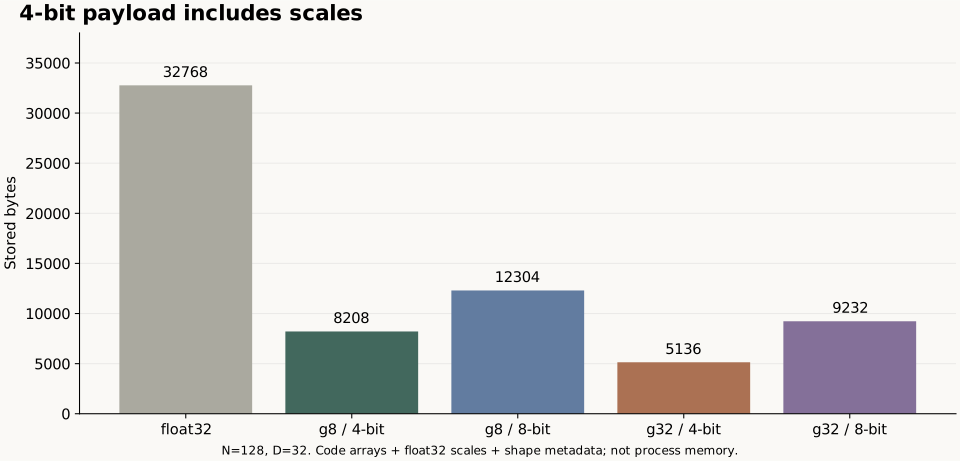
The unquantized float32 K/V payload is 32,768 bytes. Group-32 4-bit codes occupy 4,096 bytes, but scales and shapes bring the total to 5,136: approximately 84.3% less, not exactly 87.5%. Group 8 consumes more space and produces lower error on these inputs.
Moving from 0.743% to 13.450% is not “nearly lossless.” Task tolerance requires real-model quality measurements. This study has no accuracy, perplexity or generated answers.
Audit the representation, not the filename
arrays.npz preserves Q/K/V, references, packed bytes, scales, shapes and outputs. The independent auditor extracts each nibble and recomputes attention with a separate expression; it does not import the implementation's decoder.
Compressed NPZ size is not cache size: the archive duplicates alternatives and its compression depends on values. Payload totals cover arrays only, excluding Python containers, allocator overhead, temporary decoded arrays and other model layers.
Exercise and troubleshooting
Decode D2 manually, then check it with masking and shifting. All-zero input uses scale 1 and should reconstruct exact zeros. Incorrect non-divisible shapes suggest cropping/transposition mistakes. If a “4-bit” array remains the same size as 8-bit, check whether values were actually packed.
See KIVI for the granularity and residual-cache research questions. This symmetric 4/8-bit NumPy study does not reproduce its asymmetric 2-bit system. Next, keep the codec fixed and test whether recent Tokens deserve the high-precision budget.
Reproduce the protocol
Run from a fresh checkout in PowerShell. The output directory must not exist. All three articles in this study share one frozen protocol; run it once and inspect the section relevant to each article.
git clone https://github.com/VirtualSelect/hohoo-ai-lab.git hohoo-ai-lab-study
cd hohoo-ai-lab-study
git checkout 0d4009cf840052c3111bbfc40dce900326daa3ae
python -m venv .venv
$py = '.\.venv\Scripts\python.exe'
& $py -m pip install -r experiments/12-packed-kv/requirements.txt
& $py -m unittest discover -s experiments/12-packed-kv -p "test_*.py"
& $py experiments/12-packed-kv/run.py --out experiments/12-packed-kv/target/my-run
& $py experiments/12-packed-kv/audit.py experiments/12-packed-kv/target/my-run
Tested on Windows with Python 3.12.14 + NumPy 2.2.6; 4 unit tests, 144 comparisons and 810 raw timings. The independent audit should print PASS. Other operating systems have not been rechecked. To inspect the archived result without rerunning the experiment, pass experiments/12-packed-kv/evidence to the same audit command. Source hashes normalize LF; evidence hashes use original bytes. Do not rewrite the manifest to conceal a mismatch.
If an import fails, verify that installation and execution use the same $py. Preserve failed outputs and choose a new directory for reruns. Numeric comparisons use the frozen tolerances; timing is a local measurement, not a required speed threshold.
Code and writing are AI-assisted; the findings are limited to the archived, auditable runs. No new paid model requests were made, and this does not claim author-performed manual review.
A note to your future selfBefore you move on, keep one thought of your own.
Your private reading note stays in this browser; it is never uploaded or published. Clearing browser data removes it, so export a copy to keep. This article’s translations share the same note.
Next published article:KV residual windows: do recent tokens deserve higher precision? →
You are here
UNDERSTAND / LLM
- ○ KV quantization axes: why Key and Value need separate reasoning
- ○ Packed KV groups: what does 4-bit actually save?
- ○ KV residual windows: do recent tokens deserve higher precision?
KEEP EXPLORING
Related content
- LAB / 043
Packed KV, residual windows and block cost
144 comparisons and 810 timings. Recent float32 windows help recent-focused attention more; block decoding reduces work arrays but is slower on this CPU run.
- PROJECT / 002
Java LLM Practice
Reproducible Java conversation, retry and persistence boundaries, alongside attention, cache-cost and quantization-error experiments.
Which way next?
- KV quantization axes: why Key and Value need separate reasoning →
162 archived INT8 comparisons examine tensor, token and K-channel/V-token scales, including cases where the hybrid loses.
Based on article relationships and published same-topic content, not random recommendations.