

Learn / Practice
KV residual windows: do recent tokens deserve higher precision?
llm / UNDERSTAND · Mechanisms
Compare early-focused and recent-focused attention to explain unequal gains from the same float32 window.
What was published after this article?
The original conclusions and next-step proposals are retained. These published follow-ups do not imply that every limitation has been resolved.
KEEP EXPLORING
Related content
- Mechanisms
Block KV decoding: less workspace, more time
Separate cache payload, work arrays and observed runtime, retaining 810 timings including slower block decoding.
View count unavailable
On this page 6
Pinned code · Archived evidence · Study protocol
Keeping recent KV in float32 while quantizing older positions is an intuitive compromise. Yet recency describes position, not necessarily what the current query uses. This experiment makes that assumption visible with matched early-focused and recent-focused inputs.
These are synthetic attention mechanisms, not trained weights, text questions or measured task quality.
Who receives the precision budget?
[older Tokens: grouped 4-bit] [last R Tokens: float32]
              N-R                        R
The older section uses group 32 with K grouped across Tokens per channel and V across features per Token. R is 0, 16 or 64: three settings over 18 inputs produce 54 comparisons. Every method attends to the entire context; older Tokens are quantized, not removed.
For early_focus and recent_focus, the same base random arrays are modified only in the first Q/K channel to favor the first or last 16 positions. Other channels retain random variation. This is neither natural-language evaluation nor manually one-hot attention.
Measure attention allocation before interpreting error
Reference attention measures how much probability mass falls in the recent window. Errors below average per-input relative L2 error across three seeds and two lengths:
| Distribution | R=0 error | R=16 error | R=64 error | Reference mass protected by R=16 |
|---|---|---|---|---|
| Clean | 13.450% | 12.863% | 11.477% | 8.28% |
| Early focus | 13.386% | 13.366% | 13.365% | 1.23% |
| Recent focus | 11.583% | 1.150% | 1.038% | 77.19% |
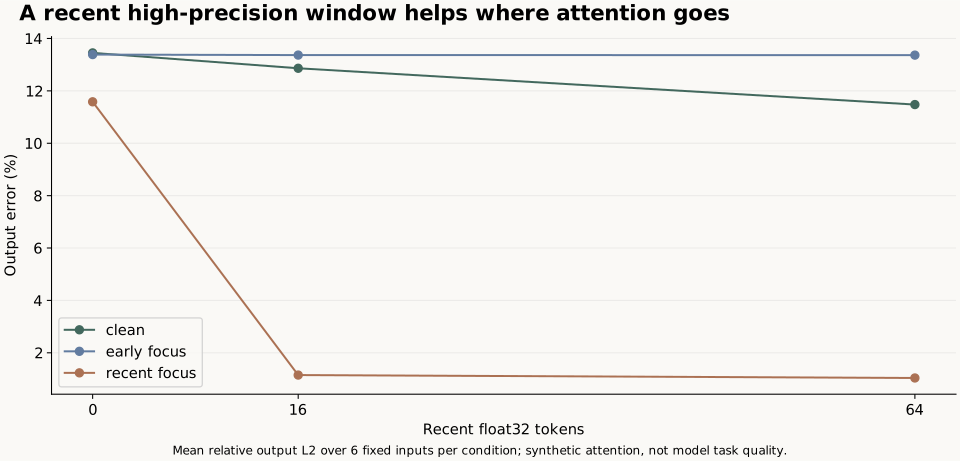
Protecting 16 recent positions sharply reduces local output error when attention focuses there. Expanding to 64 adds little. With early focus, the same expense barely helps because the heavily used older KV remains quantized.
Reference mass is an explanatory measurement, not an online oracle available at no cost. These results do not implement content-aware cache allocation or establish answer correctness.
Residual precision consumes compression gains
At N=128, the full float32 cache is 32,768 bytes:
| Recent float32 Tokens | Array payload | Reduction from full float32 |
|---|---|---|
| 0 | 5,136 B | 84.3% |
| 16 | 8,912 B | 72.8% |
| 64 | 18,960 B | 42.1% |
Totals include padded groups, scales and shapes. N-R need not be divisible by 32, so a linear “bits times remaining elements” estimate is insufficient. The audit uses saved array sizes.
Sixteen Tokens are 12.5% of a 128-token cache but 3.125% of a 512-token cache. The combined averages describe this protocol; they cannot choose a production R. Multiple layers, heads, sessions, paging and moving Tokens out of the residual window introduce additional costs.
Static representation is not online maintenance
This experiment constructs a cache once and evaluates attention. It does not generate token by token or continually quantize the oldest residual entries. It does not reproduce the complete KIVI residual mechanism.
The representation's error and size are auditable, but they say nothing about dynamic-update latency or temporary allocations. The next article tests block decoding separately: can it reduce particular decoded arrays while preserving the same quantized result, and at what CPU cost?
Exercise and troubleshooting
Inspect one early_focus input at R=0 and R=64 alongside attention_mass. If more storage buys little improvement, reconsider the recency assumption. An alternative protecting the earliest 16 positions deserves a new protocol/output directory, not insertion into these 54 frozen comparisons.
Beware Python's x[-0:], which returns the full array. The implementation uses cut=N-R; x[cut:]. If output unexpectedly matches the unquantized reference exactly, check that the original K/V was not accidentally passed to attention.
Reproduce the protocol
Run from a fresh checkout in PowerShell. The output directory must not exist. All three articles in this study share one frozen protocol; run it once and inspect the section relevant to each article.
git clone https://github.com/VirtualSelect/hohoo-ai-lab.git hohoo-ai-lab-study
cd hohoo-ai-lab-study
git checkout 0d4009cf840052c3111bbfc40dce900326daa3ae
python -m venv .venv
$py = '.\.venv\Scripts\python.exe'
& $py -m pip install -r experiments/12-packed-kv/requirements.txt
& $py -m unittest discover -s experiments/12-packed-kv -p "test_*.py"
& $py experiments/12-packed-kv/run.py --out experiments/12-packed-kv/target/my-run
& $py experiments/12-packed-kv/audit.py experiments/12-packed-kv/target/my-run
Tested on Windows with Python 3.12.14 + NumPy 2.2.6; 4 unit tests, 144 comparisons and 810 raw timings. The independent audit should print PASS. Other operating systems have not been rechecked. To inspect the archived result without rerunning the experiment, pass experiments/12-packed-kv/evidence to the same audit command. Source hashes normalize LF; evidence hashes use original bytes. Do not rewrite the manifest to conceal a mismatch.
If an import fails, verify that installation and execution use the same $py. Preserve failed outputs and choose a new directory for reruns. Numeric comparisons use the frozen tolerances; timing is a local measurement, not a required speed threshold.
Code and writing are AI-assisted; the findings are limited to the archived, auditable runs. No new paid model requests were made, and this does not claim author-performed manual review.
A note to your future selfBefore you move on, keep one thought of your own.
Your private reading note stays in this browser; it is never uploaded or published. Clearing browser data removes it, so export a copy to keep. This article’s translations share the same note.
Next published article:Block KV decoding: less workspace, more time →
You are here
UNDERSTAND / LLM
- ○ Packed KV groups: what does 4-bit actually save?
- ○ KV residual windows: do recent tokens deserve higher precision?
- ○ Block KV decoding: less workspace, more time
KEEP EXPLORING
Related content
- LAB / 043
Packed KV, residual windows and block cost
144 comparisons and 810 timings. Recent float32 windows help recent-focused attention more; block decoding reduces work arrays but is slower on this CPU run.
- PROJECT / 002
Java LLM Practice
Reproducible Java conversation, retry and persistence boundaries, alongside attention, cache-cost and quantization-error experiments.
Which way next?
- Packed KV groups: what does 4-bit actually save? →
Store real nibbles and audit group-scale overhead, padding bytes and attention output error.
Based on article relationships and published same-topic content, not random recommendations.