

Learn / Practice
Embodied AI VIII: what should the gripper do after a drop alarm?
EMBODIED-AI / EXPLORE · Engineering cases
Fifteen fixed-scene rollouts compare hold, open and open-then-retreat after identical alarms.
What was published after this article?
The original conclusions and next-step proposals are retained. These published follow-ups do not imply that every limitation has been resolved.
KEEP EXPLORING
Related content
- Engineering cases
Embodied AI IX: a release command is not verified placement
Apply single-capture and sustained-window checks to five actual trajectories, including forged observations and post-completion disturbance.
View count unavailable
On this page 7
Reproduce from a clean checkout · this article’s revision
Windows PowerShell with Python 3.12. Use a new directory, not a working copy with unsaved changes. Each article pins its own revision; the first article’s revision does not contain later experiments.
git clone https://github.com/VirtualSelect/hohoo-embodied-agent.git hohoo-embodied-agent-study
cd hohoo-embodied-agent-study
git checkout 497d0df30c1f66de50fb38b930f0c6ea069d9634
python -m venv .venv
$py = '.\.venv\Scripts\python.exe'
& $py -m pip install -r requirements-lock.txt
& $py experiments/vl01_exit_release_budget/run.py --out outputs/my-run
& $py experiments/vl01_exit_release_budget/audit.py outputs/my-run
Expect raw trajectories, summaries and audit results. Use a new output directory to preserve earlier results; runners differ in how they handle existing directories. E8–E10 share one experiment runner. No model calls are made; run the numeric experiment first and use the article’s separate replay command for video.
Troubleshooting: a missing experiment directory usually means the wrong revision; import failures require checking the interpreter and environment. OpenGL errors concern rendering steps. On Linux/macOS use .venv/bin/python; those platforms have not been retested.
Inspect the pinned code ↗Pinned code · Raw evidence and audit · Experiment record
The phase-contract experiment eliminated a false stop during normal lowering but exposed a later failure: after a correct late-drop alarm, the cube still touched both fingers and the tray. More monitoring predicates cannot directly fix the post-alarm action.
This study holds the alarm logic fixed and changes actuator targets after stopping. The scene remains an educational Cartesian gripper, not a physical robot.
1. Holding a target is not a hardware stop
Position actuators continue acting on their targets. Holding the last command neither freezes physics nor zeros velocity or force. After a forced-opening fault ends, the hold policy restores the saved closed-finger target, leaving residual contact. That is not a designed regrasp.
Only actuator targets are changed; no qpos teleport moves the cube. See MuJoCo simulation documentation for the stepping model.
2. Three exit actions
The E7 monitor is unchanged: bilateral contact and a distance below 5 cm, plus height above 12 cm during transfer only. Bad captures spanning 40 ms or capture age reaching 60 ms latch a stop.
| Policy | Next control step | Later action |
|---|---|---|
| hold | Retain all targets | No recovery |
| open | Retain XYZ, set fingers to 0 | Stay open |
| open-retreat | Same opening | After 200 ms, raise Z target 100 mm over 600 ms |
Five conditions × three actions produce 15 deterministic rollouts, each with 2 ms physics steps and 20 ms observations. All run for 12 s, with the final 0.5 s checked for placement. This is not a randomized success-rate estimate.
3. Complete outcomes
| Condition | Alarm | Hold | Open | Open-retreat |
|---|---|---|---|---|
| Clean | None | Pass | Pass | Pass |
| Transfer opening 4.8–5.04 s | 4.842 s | Fail | Fail | Fail |
| Early lowering opening 5.6–5.84 s | 5.642 s | Pass | Pass | Pass |
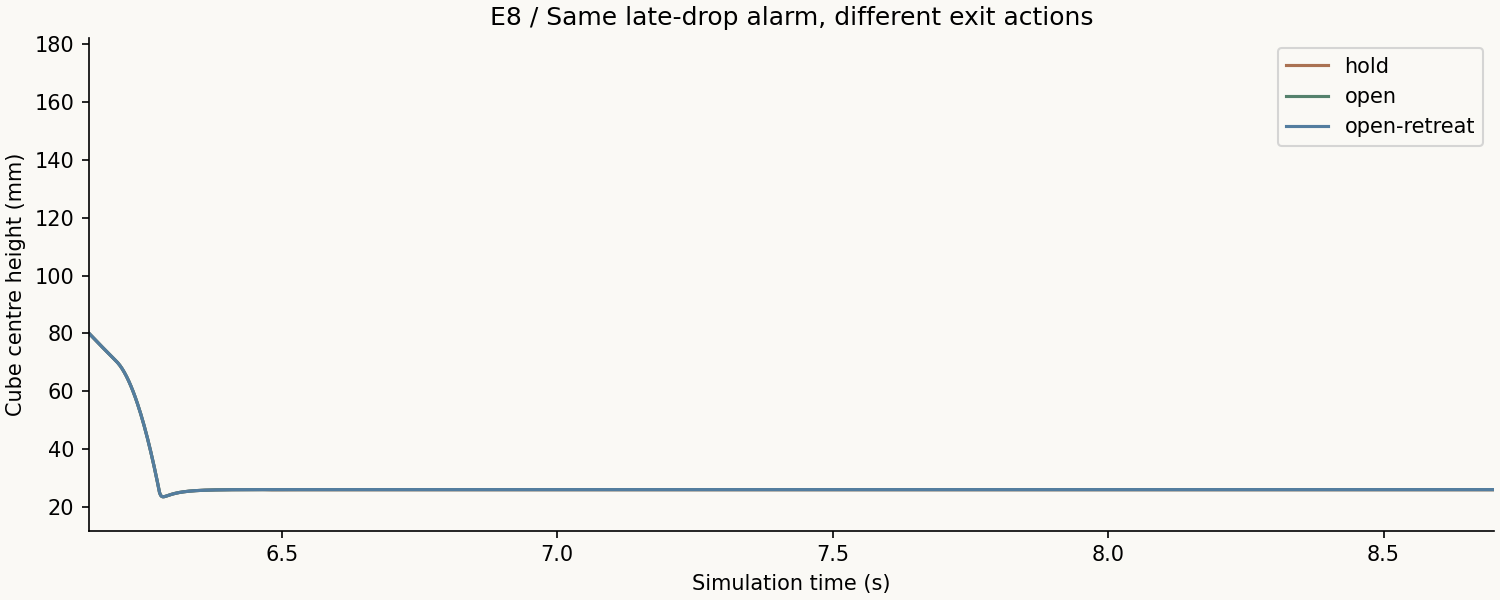
| Late lowering opening 6.2–6.44 s | 6.242 s | Fail | Pass | Pass |
| Lowering silence 5.6–5.84 s | 5.642 s | Fail | Pass | Pass |
Fifteen pairwise pre-alarm state prefixes were independently checked and match within each condition.
4. Interpret passes carefully
Late-drop hold ends with bin_floor|left_pad|right_pad, whereas both opening policies end with only bin_floor. Cube heights are approximately 25.920 mm and 25.980 mm; contact separation, rather than that small height difference, explains the acceptance change.
Opening during observation silence also passes because the cube is already above the tray. This does not establish that opening with unreliable observations is generally safe. The scene has a known support surface and no fragile objects, people or force limits.
All transfer-drop runs fail on the floor. No policy regrasped or relocated the object. Early-drop passes likewise do not prove that planned release was executed correctly.
5. Did retreat add value?
Opening and opening-then-retreat have identical final acceptance across these five conditions. The extra motion changes the hand path, but no improvement in success, force or collision margin is established. Those require separate measurements.
The test contains no recovery gate, vision regrasp or force-peak analysis. A complete exit policy needs spatial and support context, not merely an alarm boolean.
6. Reproduce
python -m unittest discover -s experiments/vl01_exit_release_budget -p "test_*.py"
python experiments/vl01_exit_release_budget/run.py --out evidence/my-exit-series
python experiments/vl01_exit_release_budget/audit.py evidence/my-exit-series
The runner executes all 32 E8–E10 rollouts. Each retains 2 ms control logs,20 ms state snapshots and summaries. Recorded versions are Python 3.12.14, MuJoCo 3.3.7 and NumPy 2.2.6. Auditing checks recorded state projections and decisions, not independently recomputed contact forces.
Next, distinguish issuing an opening command from verified placement.
Read this series
A note to your future selfBefore you move on, keep one thought of your own.
Your private reading note stays in this browser; it is never uploaded or published. Clearing browser data removes it, so export a copy to keep. This article’s translations share the same note.
Next published article:Embodied AI IX: a release command is not verified placement →
You are here
EXPLORE / Getting started with embodied AI
- ○ Embodied AI Practice VII: Why a Transfer Rule Stops Normal Lowering
- ○ Embodied AI VIII: what should the gripper do after a drop alarm?
- ○ Embodied AI IX: a release command is not verified placement
KEEP EXPLORING
Related content
- LAB / 016
E8 / Post-alarm exit actions
Fifteen fixed-scene rollouts compare hold, open and open-then-retreat after identical alarms.
- PROJECT / 003
Hohoo Embodied Experiments
Two MuJoCo teaching scenes—pick-and-place and planar force control—record contracts, tuning, clearance and delayed-feedback outcomes, including failures.
- Engineering cases
Embodied AI X: why can a recovery budget stop a recoverable task?
Twelve rollouts compare unlimited recovery, a two-resume cap and a 400 ms cooldown, separating bounded behavior from task completion.
- Engineering cases
Embodied AI IX: a release command is not verified placement
Apply single-capture and sustained-window checks to five actual trajectories, including forged observations and post-completion disturbance.
Which way next?
- Embodied AI Practice VII: Why a Transfer Rule Stops Normal Lowering →
21 MuJoCo rollouts separate stage-specific grasp checks, stop actions and final placement. A false alarm and lingering finger contact reveal two different failure modes.
- Embodied AI X: why can a recovery budget stop a recoverable task? →
Twelve rollouts compare unlimited recovery, a two-resume cap and a 400 ms cooldown, separating bounded behavior from task completion.
- Embodied AI IX: a release command is not verified placement →
Apply single-capture and sustained-window checks to five actual trajectories, including forged observations and post-completion disturbance.
Based on article relationships and published same-topic content, not random recommendations.