

Learn / Practice
MuJoCo velocity estimation: smoother signals can mean worse control
EMBODIED-AI / EXPLORE · Engineering cases
54 actual simulation rollouts compare finite differences, EMA and an oracle reference across position noise and observation delay.
What was published after this article?
The original conclusions and next-step proposals are retained. These published follow-ups do not imply that every limitation has been resolved.
KEEP EXPLORING
Related content
- Engineering cases
MuJoCo controller tuning: best candidate is not a passing controller
Select on 54 development episodes, then check position error and stable completion on 36 held-out episodes.
View count unavailable
On this page 5
Reproduce from a clean checkout · this article’s revision
Windows PowerShell with Python 3.12. Use a new directory, not a working copy with unsaved changes. Each article pins its own revision; the first article’s revision does not contain later experiments.
git clone https://github.com/VirtualSelect/hohoo-embodied-agent.git hohoo-embodied-agent-study
cd hohoo-embodied-agent-study
git checkout 1c2f0198564c4b8ff7a62d74ae51d7a13e038b1f
python -m venv .venv
$py = '.\.venv\Scripts\python.exe'
& $py -m pip install -r requirements-lock.txt
& $py experiments/planar_velocity_estimation/run.py --out outputs/my-run
& $py experiments/planar_velocity_estimation/audit.py outputs/my-run
Expect raw trajectories, summaries and audit results. Use a new output directory to preserve earlier results; runners differ in how they handle existing directories. E8–E10 share one experiment runner. No model calls are made; run the numeric experiment first and use the article’s separate replay command for video.
Troubleshooting: a missing experiment directory usually means the wrong revision; import failures require checking the interpreter and environment. OpenGL errors concern rendering steps. On Linux/macOS use .venv/bin/python; those platforms have not been retested.
Inspect the pinned code ↗Reproduction correction, 2026-10-11: Git newline conversion in the original pinned commit
1931effchanged the bytes ofresults.json, breaking its checkout-time hash audit. Links and checkout commands below now use the byte-preserving fix. The measurements, publication date and conclusions are unchanged.
Pinned code · 54 compressed trajectories · Lab
The previous predictor received ground-truth velocity at the capture timestamp, an optimistic sensor assumption. Many sensors provide positions instead. Subtracting consecutive positions gives velocity, but also differences the noise and divides it by a short interval. Feeding this directly into damping can create large force fluctuations.
This round reuses the planar force-controlled actuator. It compares finite differences, smoothed differences and an oracle velocity reference in actual MuJoCo simulation. There is no arm, vision, ROS2 or hardware. All methods hold the same delayed position and use identical gains and force limits, without position extrapolation.
From millimetres to velocity error
The sensor samples every 20ms:
measured position = true position + noise
estimated velocity = (new measured position - previous measured position) / 0.02s
For independent position-noise samples with standard deviation σ, the single-axis difference-noise standard deviation is √2 × σ / Δt. With σ=3mm and Δt=20ms, that is about 0.212m/s. This is noise propagation, not a measured result; actual error also includes the difference approximation to motion.
The controller uses force = 80 × position error - 18 × estimated velocity, clipped to ±5N per axis. A 0.212m/s noise component corresponds to roughly 3.82N in the damping term, comparable to the force bound. A position error of a few millimetres can therefore produce repeated saturation.
What smoothing changes
The EMA scheme filters the finite difference with a fixed 60ms time constant:
α = 1 - exp(-Δt / τ), τ = 60ms
smoothed velocity = (1 - α) × previous estimate + α × new difference
Δt is the difference between capture timestamps, not wall-clock arrival intervals. The first sample initializes velocity to zero; duplicate or out-of-order timestamps are rejected. Smoothing suppresses rapid changes but delays response during acceleration and deceleration. Damping no longer reflects motion as promptly.
Physics -> noisy position -> timestamped delay queue
-> consume arrived samples -> velocity estimate -> PD and clipping
-> MuJoCo step -> save trace and evaluate
Only the oracle reads captured ground-truth velocity. Difference and EMA do not read qvel; true velocity is separately saved for offline evaluation. Decisions can only use arrived samples, and the auditor checks sample age.
Freeze the protocol before looking at outcomes
Two delays (0/80ms), three noise levels (0/3/10mm), three estimators and three seeds give 54 rollouts. Each runs for four seconds with 2ms physics and 20ms control, producing 108,000 rows. There is no obstacle; mass is 1kg and the goal is (0.6,0).
Acceptance requires every physics step in the last 300ms to be within 15mm of the goal and below 0.04m/s in speed norm. A lucky endpoint or a small final error is insufficient.
Each table cell is passing rollouts out of three seeds:
| Delay | Position-noise σ | Oracle reference | Difference | EMA |
|---|---|---|---|---|
| 0ms | 0mm | 3/3 | 3/3 | 3/3 |
| 0ms | 3mm | 3/3 | 0/3 | 0/3 |
| 0ms | 10mm | 1/3 | 0/3 | 0/3 |
| 80ms | 0mm | 0/3 | 0/3 | 0/3 |
| 80ms | 3mm | 0/3 | 0/3 | 0/3 |
| 80ms | 10mm | 0/3 | 0/3 | 0/3 |
Thirteen rollouts pass overall. This small, fixed-scene matrix is not a robot generalization success rate.
Two results that need their full context
Smoothing reduces some estimation noise. With zero delay and 10mm noise, mean velocity-estimation RMSE across seeds falls from 0.9553m/s for differences to 0.2471m/s for EMA. Tail position RMS falls from 21.89mm to 10.01mm. Both still pass 0/3: an acceptable position RMS does not imply that position and speed meet both thresholds at every step.
Smoothing can worsen delayed control. With 80ms delay and no noise, tail position RMS is 30.32mm for differences and 93.66mm for EMA. At 3mm noise, it is 26.00mm versus 123.31mm. Smoothing adds dynamic lag on top of observation delay. The protocol did not scan τ or retune gains, so this establishes degradation for these parameters, not that all filters fail.
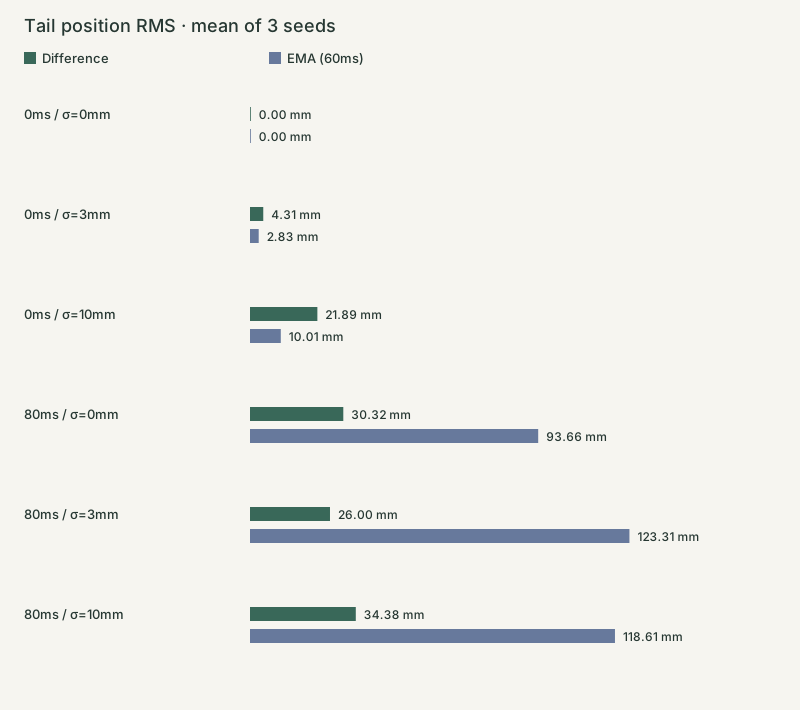
Velocity RMSE compares the estimate with true velocity at capture time. The oracle is zero by construction on this metric, yet its velocity may already be 80ms old. Even noiseless, undelayed finite differences have approximation error: displacement divided by an interval is an average velocity, not the instantaneous endpoint value.
Reproduce and diagnose
The following commands use Windows PowerShell and explicitly select the virtual-environment interpreter.
git clone https://github.com/VirtualSelect/hohoo-embodied-agent.git hohoo-embodied-agent-study
cd hohoo-embodied-agent-study
git checkout 1c2f0198564c4b8ff7a62d74ae51d7a13e038b1f
python -m venv .venv
$py = '.\.venv\Scripts\python.exe'
& $py -m pip install -r requirements-lock.txt
& $py -m unittest discover -s experiments/planar_velocity_estimation -p "test_*.py"
& $py experiments/planar_velocity_estimation/run.py --out outputs/velocity-my-run
& $py experiments/planar_velocity_estimation/audit.py outputs/velocity-my-run
The tested environment is Windows, Python 3.12.14, MuJoCo 3.3.7 and NumPy 2.2.6. Other operating systems were not retested. No rendering window, GPU, model key or paid service is required. Expect four estimator tests to pass, then 54 episodes, 108000 rows and 13 successes. The audit independently checks hashes, timestamps, estimates, force and acceptance.
csv.gz is lossless compression and can be read with Python's gzip.open(..., 'rt'). Use a separate output directory so archived evidence stays intact. If results differ, first check pinned dependencies and commit, then capture_t, estimated velocity, raw force and saturation. Do not start by relaxing acceptance thresholds. Persistent clipping suggests inspecting the derivative estimate; smooth oscillation near the target calls for inspecting sample age and estimator lag.
Exercise: hand-calculate differences and EMA for three samples around a sudden deceleration. Observe why EMA retains old velocity. A follow-up should separately scan sampling period, τ and controller gains while retaining every condition. This round does not complete VL01 or establish hardware safety. The next question is the closed-loop tradeoff, not simply choosing a more elaborate filter name.
A note to your future selfBefore you move on, keep one thought of your own.
Your private reading note stays in this browser; it is never uploaded or published. Clearing browser data removes it, so export a copy to keep. This article’s translations share the same note.
Next published article:MuJoCo controller tuning: best candidate is not a passing controller →
You are here
EXPLORE / Getting started with embodied AI
- ○ Delayed MuJoCo feedback: can an old observation predict now?
- ○ MuJoCo velocity estimation: smoother signals can mean worse control
- ○ MuJoCo controller tuning: best candidate is not a passing controller
KEEP EXPLORING
Related content
- LAB / 041
MuJoCo velocity estimation: smoother signals can mean worse control
54 actual simulation rollouts compare finite differences, EMA and an oracle reference across position noise and observation delay.
- PROJECT / 003
Hohoo Embodied Experiments
Two MuJoCo teaching scenes—pick-and-place and planar force control—record contracts, tuning, clearance and delayed-feedback outcomes, including failures.
- Engineering cases
Embodied AI practice (14): does landing in the bin mean the task is complete?
Eight MuJoCo trajectories, three passive readouts and recorded-state replay separate historical placement, current evidence and qualified completion.
Which way next?
- Delayed MuJoCo feedback: can an old observation predict now? →
Twenty-four paired traces compare delay, position noise and constant-velocity prediction, retaining incomplete recoveries.
- A second MuJoCo scene: why does the actuator overshoot? →
Compare mass and PD damping in a planar force-controlled actuator, separating target crossing from stable completion.
- Embodied AI practice (14): does landing in the bin mean the task is complete? →
Eight MuJoCo trajectories, three passive readouts and recorded-state replay separate historical placement, current evidence and qualified completion.
Based on article relationships and published same-topic content, not random recommendations.