

Learn / Practice
LLM mechanics I: should changing future tokens affect earlier outputs?
llm / UNDERSTAND · Mechanisms
From a two-row hand calculation to a two-layer numeric experiment: causal masks, softmax and future-information leakage.
What was published after this article?
The original conclusions and next-step proposals are retained. These published follow-ups do not imply that every limitation has been resolved.
KEEP EXPLORING
Related content
- Mechanisms
LLM mechanics II: what does KV caching save, and how do we verify it?
Compare prefix recomputation, token decoding and chunk caching with output errors, projected-row counts and actual array payloads.
View count unavailable
On this page 6
Pinned code · Raw evidence and audit · Experiment record
The earlier context-position study observed a model through its API. This series inspects the computation itself: which positions are permitted to influence which outputs?
Our network is untrained: 32 discrete IDs,16-dimensional representations, two single-head attention layers, and tanh(x + attention(x)) residual updates. It uses absolute sinusoidal positions and float64. There is no tokenizer, FFN, normalization, dropout, language-quality test or Agnes request. We test computation, not linguistic competence.
1. Start with a hand calculation
Set Q and K to zero. Let the value rows be [2,4] and [6,8]. All scores are zero, so softmax averages the permitted values.
| Query | Allowed keys | Weights | Output |
|---|---|---|---|
| 0 | 0 | [1,0] |
[2,4] |
| 1 | 0, 1 | [0.5,0.5] |
[4,6] |
Without a causal mask, both rows would output [4,6]; the first would use a future value. A unit test fixes these hand-derived answers instead of relying entirely on two implementations agreeing.
2. Mask before softmax
scores = q @ k.T / np.sqrt(d)
allowed = key_positions[None, :] <= query_positions[:, None]
scores = np.where(allowed, scores, -np.inf)
ex = np.exp(scores - scores.max(axis=1, keepdims=True))
weights = ex / ex.sum(axis=1, keepdims=True)
output = weights @ v
Forbidden entries contribute zero exponentials. Clearing weights after softmax without renormalizing would change the output scale. An all-masked row is rejected, avoiding undefined arithmetic. Subtracting the row maximum prevents exponential overflow without changing the normalized distribution; a separate large-score test checks this behavior.
Score scaling and causal masking serve different purposes. One should not describe the mask merely as a numerical-stability trick.
3. Perturb only the future
The 24 input IDs follow tokens[i]=(7*i+3)%32. Only indices 12–23 are changed by adding 1 modulo 32. We compare the largest absolute coordinate change in the first twelve final representations, using seeds 7, 19, 41 frozen before execution.
| Seed | Causal change | Unmasked change |
|---|---|---|
| 7 | 0 | 0.139619 |
| 19 | 0 | 0.081980 |
| 41 | 0 | 0.328622 |
These are hidden-state coordinate differences, not accuracy, confidence or loss. The nonzero negative controls demonstrate that the fixture can expose future leakage rather than being insensitive to the modification.
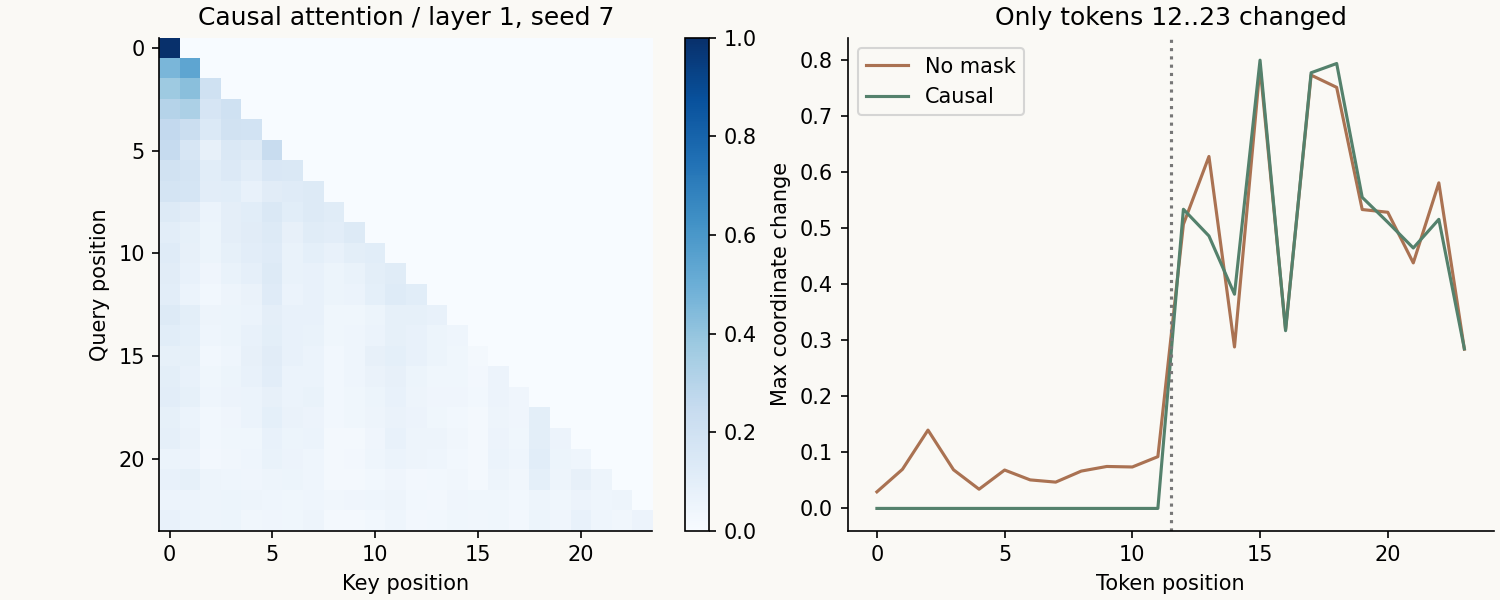
The left panel contains actual first-layer weights for seed 7. The right uses the complete two-layer output. Changes to the right of the dashed boundary are expected: those inputs were changed directly.
4. Why causality survives another layer
At layer 1, position i depends only on positions 0 through i. Layer 2 at i reads their layer 1 representations, which likewise contain no information from after i. Positionwise residual updates and activations preserve this dependency boundary.
The reasoning assumes identical parameters and positions, correct masks, and no additional cross-position operation leaking future information. It motivates a useful implementation test, but this experiment contains no training loss and establishes no training benefit.
5. Reproduce
python -m unittest discover -s experiments/05-attention-lab -p "test_*.py"
python experiments/05-attention-lab/run.py --out experiments/05-attention-lab/evidence/my-run
python experiments/05-attention-lab/audit.py experiments/05-attention-lab/evidence/my-run
Recorded versions: Python 3.12.14 and NumPy 2.2.6. Nine test methods include 36 seed/length/window chunk comparisons. The archive contains 48 named arrays. An auditor that does not import the decoder recomputes 27 numeric differences plus mask structure and operation counts.
Continue with KV-cache equivalence: if old positions could read future tokens, appending a token could invalidate old cached states. General attention background comes from the Transformer paper; these measurements belong to the simplified local implementation, not that paper's translation experiments.
Read this series
A note to your future selfBefore you move on, keep one thought of your own.
Your private reading note stays in this browser; it is never uploaded or published. Clearing browser data removes it, so export a copy to keep. This article’s translations share the same note.
Next published article:LLM mechanics II: what does KV caching save, and how do we verify it? →
You are here
UNDERSTAND / LLM
- ○ KV Cache explained — why send the conversation history again?
- ○ LLM mechanics I: should changing future tokens affect earlier outputs?
- ○ LLM mechanics II: what does KV caching save, and how do we verify it?
KEEP EXPLORING
Related content
- LAB / 015
L2–L4 / Attention and cache mechanics
From a two-row hand calculation to a two-layer numeric experiment: causal masks, softmax and future-information leakage.
- PROJECT / 002
Java LLM Practice
Reproducible Java conversation, retry and persistence boundaries, alongside attention, cache-cost and quantization-error experiments.
- Mechanisms
LLM mechanics II: what does KV caching save, and how do we verify it?
Compare prefix recomputation, token decoding and chunk caching with output errors, projected-row counts and actual array payloads.
- Mechanisms
LLM mechanics III: why is a four-slot cache not four-token recomputation?
Separate absolute positions, cache slots and retained representations with a two-layer sliding-attention experiment.
Which way next?
- LLM mechanics II: what does KV caching save, and how do we verify it? →
Compare prefix recomputation, token decoding and chunk caching with output errors, projected-row counts and actual array payloads.
- KV Cache explained — why send the conversation history again? →
Derive K/V reuse from causal attention, calculate cache memory, and separate inference caching from prefix reuse and chat history.
- LLM mechanics III: why is a four-slot cache not four-token recomputation? →
Separate absolute positions, cache slots and retained representations with a two-layer sliding-attention experiment.
Based on article relationships and published same-topic content, not random recommendations.