

Learn / Practice
LLM mechanics II: what does KV caching save, and how do we verify it?
llm / UNDERSTAND · Mechanisms
Compare prefix recomputation, token decoding and chunk caching with output errors, projected-row counts and actual array payloads.
What was published after this article?
The original conclusions and next-step proposals are retained. These published follow-ups do not imply that every limitation has been resolved.
KEEP EXPLORING
Related content
- Mechanisms
LLM mechanics III: why is a four-slot cache not four-token recomputation?
Separate absolute positions, cache slots and retained representations with a two-layer sliding-attention experiment.
- Mechanisms
Tiled attention: preserving results without a full score matrix
Derive online softmax from a failing block-average baseline and separate smaller temporaries from measured speed.
View count unavailable
On this page 7
Pinned code · Raw evidence and audit · Experiment record
The earlier KV-cache explanation separated inference caches from chat history. Here we verify reuse numerically with the causal-attention implementation, holding all 24 input IDs and model parameters fixed.
This is an untrained two-layer network. There is no hosted-model comparison, downloaded language model or GPU speed benchmark.
1. Compare the same output
The reference is a 24×16 representation matrix from one full causal forward pass. Prefix recomputation processes lengths 1 through 24 and takes each final row. Token decoding processes one new ID at a time. Chunk decoding uses blocks of 5, 3, 7, 9 and retains all new rows.
We compare hidden states at corresponding positions, not shifted next-token predictions or sampled text.
2. Keep K/V separately for every layer
k = concatenate(old_k, new_k)
v = concatenate(old_v, new_v)
output = attention(new_q, k, v, query_positions, key_positions)
Old queries are unnecessary for the new position's computation. Each layer stores its own keys, values and positions because its projections receive different inputs. Tests also verify that a chunk call does not mutate the input cache, permitting independent prefix branches. This implementation uses copies, not a production shared-block allocator.
3. Cached chunks need an offset mask
With five cached positions and three new tokens, queries are at 5, 6, 7 and keys at 0–7:
q5: 1 1 1 1 1 1 0 0
q6: 1 1 1 1 1 1 1 0
q7: 1 1 1 1 1 1 1 1
Numbering the new query rows 0, 1, 2 incorrectly excludes most old context. Output shapes can still look valid. In our negative control, the resulting maximum errors were 0.589838, 0.739833, 0.648703 for the three seeds. Correct chunk processing stayed within 3.89e-16.
4. Count work without claiming a speedup
| Recorded count: 24 tokens, two layers | Prefix recomputation | Token cache |
|---|---|---|
| Input rows projected into Q/K/V | 1800 | 144 |
| Allocated attention-score elements | 9800 | 600 |
| Final retained K/V payload | Not retained across steps | 12288 bytes |
Projection counts are 3×2×Σt and 3×2×24. Score counts are 2×Σt² and 2×Σt, including entries later masked in the allocated square reference matrices. K/V payload is 2×2×24×16×8=12288 bytes.
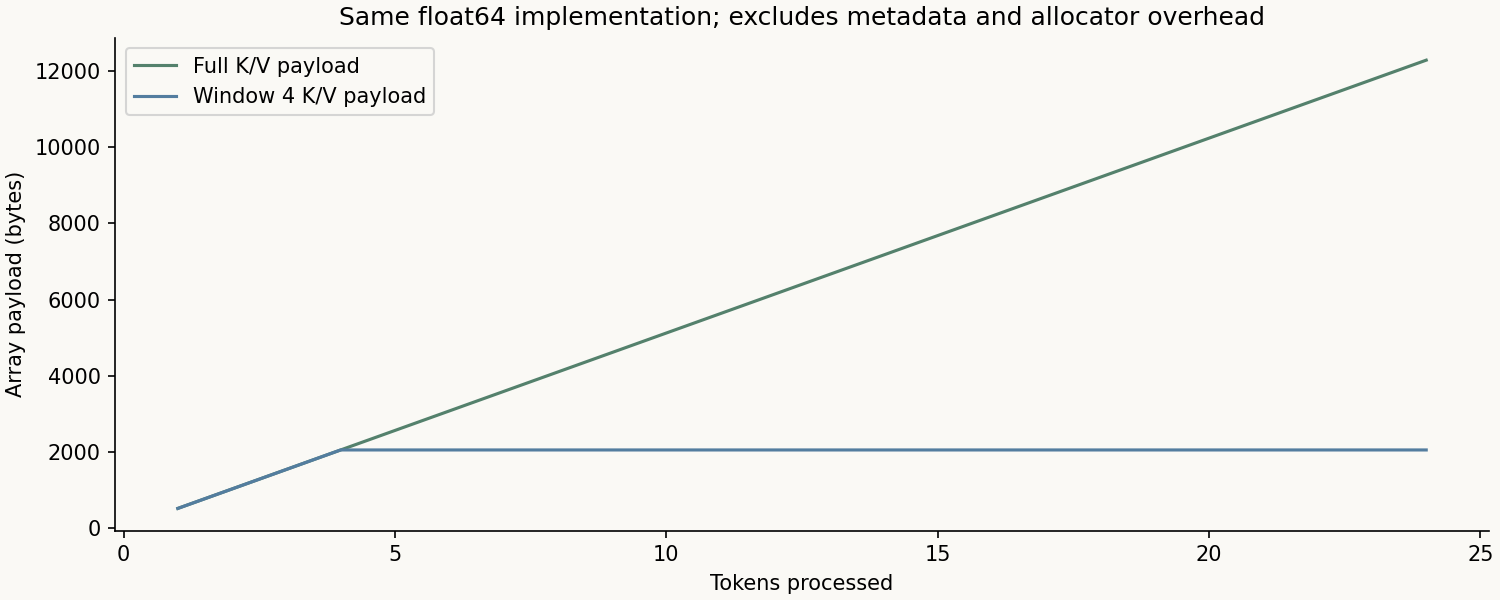
Payload excludes positions, temporary copies, weights, Python objects and allocator overhead. Batched kernels, copying and hardware parallelism affect actual runtime, so these counts are not a wall-clock speedup ratio. Runtime was not an experimental metric.
5. How equivalent were the paths?
All three seeds kept prefix, token and chunk output differences below the frozen 1e-12 tolerance. The largest token-cache difference was 5.55e-16 in float64. This does not imply bitwise equality across quantization, lower precision, dropout or different backends.
Parameters, inputs, positions and masks must agree. Editing the prefix invalidates any assumption that its old cache remains reusable.
6. Reproduce
python experiments/05-attention-lab/run.py --out experiments/05-attention-lab/evidence/my-cache-run
python experiments/05-attention-lab/audit.py experiments/05-attention-lab/evidence/my-cache-run
Inspect full, prefix, cached and chunked in the saved arrays. The tests cover different lengths, chunks and windows. The next experiment asks whether retaining four cached positions is equivalent to recomputing just the latest four raw tokens.
See the Hugging Face caching explanation for general background. The measurements above belong to this simplified implementation, not that library's performance.
Read this series
A note to your future selfBefore you move on, keep one thought of your own.
Your private reading note stays in this browser; it is never uploaded or published. Clearing browser data removes it, so export a copy to keep. This article’s translations share the same note.
Next published article:LLM mechanics III: why is a four-slot cache not four-token recomputation? →
You are here
UNDERSTAND / LLM
- ○ LLM mechanics I: should changing future tokens affect earlier outputs?
- ○ LLM mechanics II: what does KV caching save, and how do we verify it?
- ○ LLM mechanics III: why is a four-slot cache not four-token recomputation?
KEEP EXPLORING
Related content
- LAB / 015
L2–L4 / Attention and cache mechanics
From a two-row hand calculation to a two-layer numeric experiment: causal masks, softmax and future-information leakage.
- PROJECT / 002
Java LLM Practice
Reproducible Java conversation, retry and persistence boundaries, alongside attention, cache-cost and quantization-error experiments.
- Mechanisms
LLM mechanics I: should changing future tokens affect earlier outputs?
From a two-row hand calculation to a two-layer numeric experiment: causal masks, softmax and future-information leakage.
- Mechanisms
LLM mechanics III: why is a four-slot cache not four-token recomputation?
Separate absolute positions, cache slots and retained representations with a two-layer sliding-attention experiment.
Which way next?
- LLM mechanics I: should changing future tokens affect earlier outputs? →
From a two-row hand calculation to a two-layer numeric experiment: causal masks, softmax and future-information leakage.
- LLM mechanics III: why is a four-slot cache not four-token recomputation? →
Separate absolute positions, cache slots and retained representations with a two-layer sliding-attention experiment.
Based on article relationships and published same-topic content, not random recommendations.