

Learn / Practice
LLM mechanics (7): why is caching slower even when it saves computation?
llm / UNDERSTAND · Mechanisms
4,860 measured queries compare three admission policies, connecting byte budgets, working sets, computation and local elapsed time.
What was published after this article?
The original conclusions and next-step proposals are retained. These published follow-ups do not imply that every limitation has been resolved.
KEEP EXPLORING
Related content
- Mechanisms
Profiling KV reuse: saved work versus added overhead
Profile 909 queries across signatures, lookup, copying and continuation, including the remaining slowdown.
View count unavailable
On this page 9
Pinned code · Raw evidence and audit · Experiment record
The previous study found an 8KiB cache repeatedly evicting checkpoints without a single hit. Saving fewer checkpoints seems like an obvious improvement. This time we measure both work and elapsed query time: admission improves some traces, yet the tiny NumPy model remains faster without caching.
Separate three questions
| Question | Check | Supported conclusion |
|---|---|---|
| Are the results equivalent? | Compare cached and full arrays for the same input with a fixed tolerance | Numerical agreement under this model and precision, not language quality |
| Is there less computation? | Count Q/K/V projection rows | These projections decrease, not necessarily every operation |
| Is the wait shorter? | Time the complete query against a no-cache baseline with repetitions | Local time for this workload, not production LLM performance |
Valid prefix hit → fewer token projections ─┐
Signature, lookup, copying, segmented calls ┼→ total query time (measure it)
Cache miss → recomputation ────────────────┘
The three-scope / 16KiB case is a counterexample: longest halves projection rows relative to all, yet remains slower than none. Retain both baselines rather than choosing the slower cache policy to claim acceleration.
Exercise: do 432 rows instead of 864 mean “50% faster”?
No. Only the projection count falls by 50%. The corresponding median is 6.723ms versus 1.697ms without caching. File access, hashing and copying are timed, but have not been profiled separately; none can be declared the dominant bottleneck from these totals.
Change admission, keep the model
The unchanged untrained Decoder has two layers, dimension 16 and vocabulary 32. Each request contains twelve tokens: an eight-token prefix and a changing four-token suffix.
| Policy | Persistent checkpoints | Query path |
|---|---|---|
none |
None | Compute all twelve tokens; no cache signature or copies |
all |
Full prefixes at tokens 4 and 8 | Find the longest matching prefix and continue |
longest |
Only the full prefix at token 8 | Same lookup, segmented computation and LRU machinery |
Both cache policies retain the same segmentation even when token-4 state is not admitted. The no-cache baseline performs genuinely ordinary computation rather than paying artificial lookup costs for symmetry.
Entries own full K/V and position arrays, without shared pages. Persistent payload costs 528 bytes per token: 2,112 bytes for four tokens and 4,224 for eight. This is array payload, not process RSS or GPU memory.
Capacity arithmetic is useful, but not sufficient
For three isolated scopes:
all:      3 × (2,112 + 4,224) = 19,008 bytes
longest:  3 × 4,224           = 12,672 bytes
16 KiB:                       16,384 bytes
The longest checkpoints fit; all checkpoints do not. Identical tokens in different scopes remain isolated.
However, failing to hold every checkpoint does not imply zero hits. At 12KiB, the two-branch all trace evicts one short checkpoint, retains both long prefixes and subsequently hits ten times. Access order and the surviving working set matter alongside capacity.
What the timer includes
Three seeds × three budgets (8, 12, 16KiB) × three traces × three policies produce 81 configurations. Each receives one excluded warm-up trace, then five measured traces. Configuration order is shuffled in each measurement block with a fixed seed; each trace starts with a fresh model object and empty cache.
The archive contains 405 measured traces / 4,860 requests, plus 972 excluded warm-up requests. Each budget/trace/policy summary aggregates fifteen trace times: three model seeds and five repetitions.
start = time.perf_counter_ns()
states, info = store.query(scope, model, tokens)
elapsed_ns = time.perf_counter_ns() - start
fresh, _ = model.full(tokens)  # outside the timing interval
Timing includes signature checks, lookup, copies, computation, admission and eviction. It excludes model construction, reference computation, output serialization and plotting. The inherited signature function reads the model source file and hashes weights on every query, so that source-file read is included. This is intentionally the existing teaching implementation, not a tuned production cache.
perf_counter_ns() provides an integer nanosecond representation for time differences; its unit does not guarantee nanosecond measurement accuracy. Python time reference
At 16KiB, less work does not mean less time
Each row covers a twelve-request trace, including the initial cold request. Times are median and minimum–maximum across fifteen measured traces.
| Trace | Policy | Hits | Q/K/V rows | Query time (ms) |
|---|---|---|---|---|
| Hot prefix | none | 0 | 864 | 1.646 (1.607–3.260) |
| Hot prefix | all | 11 | 336 | 5.921 (5.680–6.886) |
| Hot prefix | longest | 11 | 336 | 6.231 (5.679–8.648) |
| Alternating branches | none | 0 | 864 | 1.733 (1.603–3.511) |
| Alternating branches | all | 10 | 384 | 6.495 (6.036–9.840) |
| Alternating branches | longest | 10 | 384 | 6.282 (5.846–7.138) |
| Three scopes | none | 0 | 864 | 1.697 (1.612–2.126) |
| Three scopes | all | 0 | 864 | 10.263 (9.255–15.599) |
| Three scopes | longest | 9 | 432 | 6.723 (6.345–10.020) |
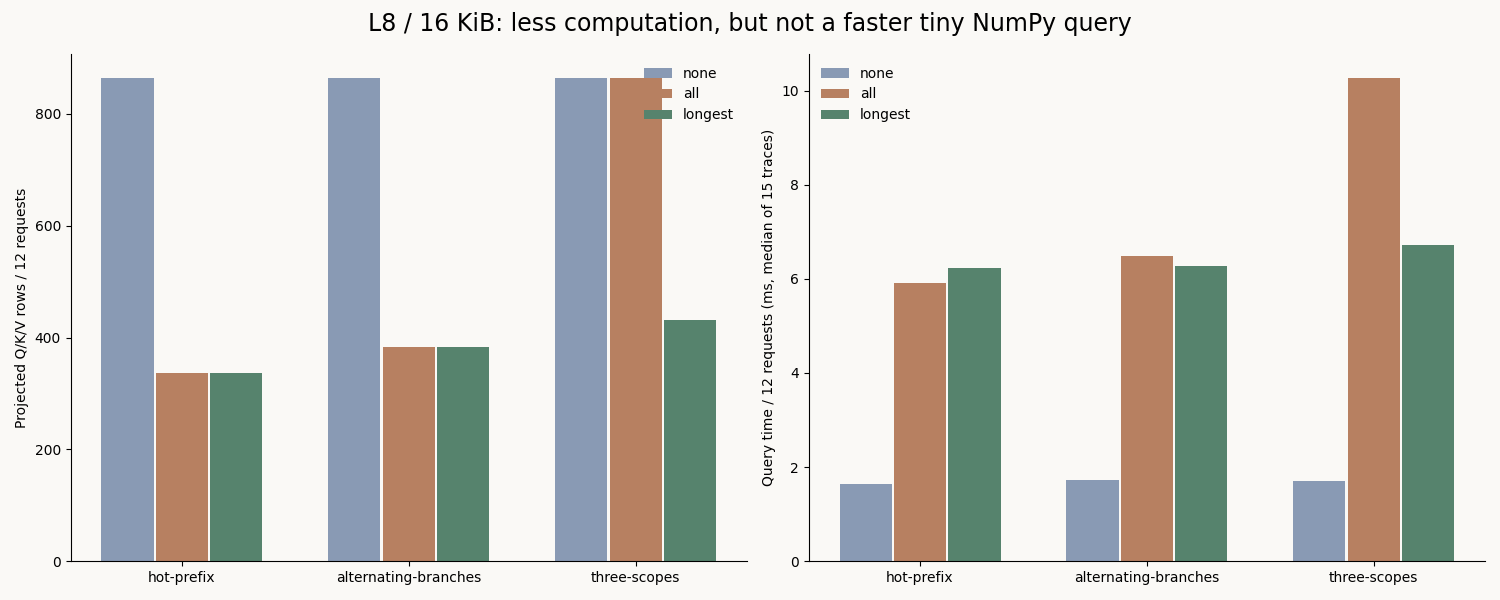
Three scopes provide the clearest admission contrast: twenty evictions become zero, rows drop from 864 to 432, and median time falls from 10.263ms to 6.723ms. Yet no caching takes 1.697ms. Improving one cache strategy is not the same as beating the no-cache baseline.
The hot trace also rejects a universal claim that longest-only is faster. Both policies hit eleven times; longest-only has a slightly higher median and overlapping ranges. No statistical significance test was performed, and no fastest repetition was selected for presentation.
An explanation, not a component-level profile
The model's matrices are tiny. The cache path still performs source/weight hashing, Python container management, owned copies and segmented calls. Fresh computation avoids that machinery.
This explanation is consistent with the code and observations, but this study does not time individual components. It cannot assign a percentage of overhead to hashing or copying. A next experiment could profile those parts and compare a model-load-time version signature with per-query signatures while retaining invalidation tests.
Simply deleting identity checks would make stale K/V reusable after weight or positional-rule changes. Returning a wrong answer faster is not an optimization.
Keep the zero-benefit cases
At 8KiB, two longest prefixes require 8,448 bytes, exceeding 8,192. Longest-only reduces evictions from 22 to 11 and explicit copying from 76,032 to 50,688 bytes, but still gets zero hits and saves no projection work.
At 12KiB, three longest prefixes require 12,672 bytes, exceeding 12,288. This trace also remains at zero hits. Admission rules cannot erase the capacity constraint.
These deterministic traces are not sampled user traffic. Their hit counts explain mechanisms rather than predict online hit rates.
Entry points and reproduction
Start with capacity and mechanisms, then equivalence, invalidation, longest-prefix reuse and byte budgets. These are completed offline numerical experiments.
The separate context branch has 24 real Agnes 3.0 calls. The later 128-case similar-distractor protocol is offline preparation only, with no new model results. Do not combine their denominators with these numerical experiments.
In a new directory, prepare Python 3.12 (PowerShell):
git clone https://github.com/VirtualSelect/hohoo-ai-lab.git hohoo-ai-lab-cache
cd hohoo-ai-lab-cache
git checkout 503f5271ef0d5baa12353d6eeda672dec5fc240e
python -m venv .venv
.\.venv\Scripts\python.exe -m pip install numpy==2.2.6
cd experiments/09-cache-admission
..\..\.venv\Scripts\python.exe -m unittest discover -s . -p test_cache.py
..\..\.venv\Scripts\python.exe run.py --out evidence/my-run
..\..\.venv\Scripts\python.exe audit.py evidence/my-run
Expect per-query records and arrays. Check numerical error, projection counts and budget invariants before interpreting time. Use a new output directory. Timing need not exactly match the archive; an error beyond the protocol tolerance is a correctness failure. For missing NumPy, check that installation and execution use the same interpreter.
Audit scope: the current script checks result-file hashes and independently recomputes some metrics, but does not traverse manifest.sources to verify source hashes. Pin the revision as well; an audit pass does not establish source identity, environment identity or production performance.
Appendix: numerical checks and archived files
All 4,860 measured requests are compared with a full reference calculation. Maximum absolute error is 4.16 × 10⁻¹⁶. The first measured repetition of each configuration archives reference and reused outputs: 1,944 arrays in total. Later repetitions retain errors and timing without duplicating arrays.
Six contract tests cover invalid policy, a one-byte capacity boundary, scope separation, model identity changes, return/cache memory isolation and longest-only admission. The independent audit replays token/scope LRU behavior without calling the Store under test.
Use the repository's Python/NumPy environment. Archived versions are Python 3.12.14 and NumPy 2.2.6. The manifest identifies frozen source, runtime, NumPy configuration, timer resolution and hashes. Raw results retain ordering, elapsed nanoseconds, work counters, copying and eviction events.
This was not a dedicated benchmark machine: no CPU affinity, GPU or production inference engine. Timing will vary. The useful discipline is to report correctness, capacity, work and elapsed time together, so the reader can see exactly what improved.
Fix follow-up · 2026-10-07
2026-10-07 correction: the audit now verifies manifest.sources and rejects changed code, missing files and paths outside the repository. The original 4,860 queries and timings remain unchanged; source-integrity checks do not provide new cache-performance results.
A note to your future selfBefore you move on, keep one thought of your own.
Your private reading note stays in this browser; it is never uploaded or published. Clearing browser data removes it, so export a copy to keep. This article’s translations share the same note.
You are here
UNDERSTAND / LLM
- ○ LLM mechanics (6): why can a larger prefix cache still get zero hits?
- ○ LLM mechanics (7): why is caching slower even when it saves computation?
- ○ Does moving an answer into the middle make a model miss it? An interrupted controlled trial
KEEP EXPLORING
Related content
- LAB / 028
LLM mechanics (7): why is caching slower even when it saves computation?
4,860 measured queries compare three admission policies, connecting byte budgets, working sets, computation and local elapsed time.
- PROJECT / 002
Java LLM Practice
Reproducible Java conversation, retry and persistence boundaries, alongside attention, cache-cost and quantization-error experiments.
- Mechanisms
LLM mechanics (6): why can a larger prefix cache still get zero hits?
324 requests across cold-start traces and 648 arrays test byte-bounded prefix checkpoints, working sets, isolation and LRU eviction.
- Mechanisms
LLM mechanics (4): when a prefix changes, is the old KV cache still valid?
Three seeds and six conditions compare unchecked and keyed prefix reuse; numerical equality does not establish permission to share across scopes.
Which way next?
- LLM mechanics (6): why can a larger prefix cache still get zero hits? →
324 requests across cold-start traces and 648 arrays test byte-bounded prefix checkpoints, working sets, isolation and LRU eviction.
- LLM mechanics (4): when a prefix changes, is the old KV cache still valid? →
Three seeds and six conditions compare unchecked and keyed prefix reuse; numerical equality does not establish permission to share across scopes.
Based on article relationships and published same-topic content, not random recommendations.